Home Blog Page 7

Jeevan Nagar: Unmasking Realities, A Finale Packed with Twists

Staying true to its signature style, Green Entertainment‘s ‘Jeevan Nagar’ weaved a well-thought-out last episode that remained consistent with all the other episodes. Like many of Kashif Nisar’s directions, ‘Jeevan Nagar’ was no different as it unmasked the horrible realities of societies while giving a ray of hope in the last episode. The episode was packed with entertainment and social messages.

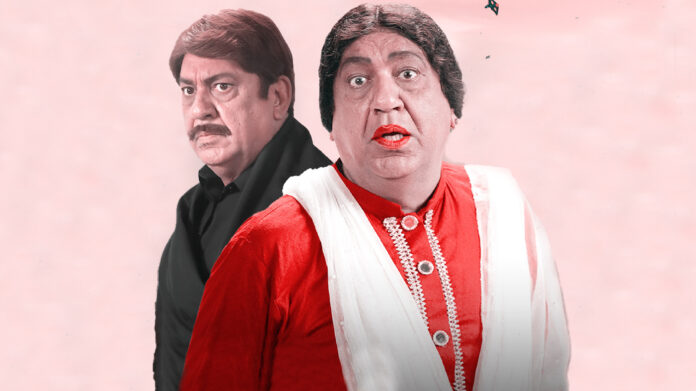
Set in the fictitious town of ‘Jeevan Nagar’, the drama discusses the plight of people in that society which resembles with everyday problems of a common man. The centre of the drama and the place ‘Jeevan Nagar’ is Babbar Shah, played by Sohail Ahmed, a figure standing as a barrier between corrupt individuals and the innocent residents of his locality. This unique town emerges as a focal point for crucial societal concerns frequently overlooked, including identity crises, social class disparities, and gender stereotypes.

Unveiling secrets, underwhelming reactions, and power-packed performances in Jeevan Nagar’s last episode

The last episode of the drama concluded in a manner that aligns with viewers’ expectations – it had sufficient plot and tension to keep them engaged, yet it avoided an excess that might have made the conclusion feel rushed.

As the drama approached its conclusion, the direction was well-executed, leading to a satisfying resolution. Laali Guru, also played by Sohail Ahmed, embarks on a guilt trip, recognizing how his greed and inaction contributed to the downfall of Jeevan Nagar. He expresses remorse for the chaos he unleashed upon the town.

The conversation between Neelo — played by Saqib Sumeer — and Laali Guru evoked strong emotions, shedding light on the challenges faced by transgenders and the corruption prevailing in society.

Simultaneously, Babu — played by Syed Atif — has his eureka moment, connecting the final dots and extracting a confession about the murder of Babbar Shah, leading to his replacement by Laali Guru, which ultimately caused chaos in Jeevan Nagar.

Munni, played by Rabia Butt, on the other hand, remains steadfast in her mission to give a voice to Jeevan Nagar residents. In her speech, as she addresses all the residents, she urges them to give up their weapons and be the driving force that makes Jeevan Nagar a place to live in. Of course, the entire speech was very important, and her action of refusing the crowd from chanting her name to switching it with Jeevan Nagar was symbolic of the fact that it is the people who can collectively make a society deserving to be lived in and make it worth it.

The drama heads towards its conclusion as it is finally revealed that Laali Guru disguised as Babbar Shah in Jeevan Nagar. That scene could have been way better executed at that point. The announcement of Babbar Shah’s death to the entire Jeevan Nagar community was a very pivotal scene where they realised that they had lost their leader; instead, the audience saw a very underwhelming reaction from the public. This was also noticeable in Rabia Butt’s performance, who in this moment gave a very underwhelming reaction on hearing the man’s death whom she had affectionate and loving feelings for, with her face covered with her mouth.

Lastly, we also see Billa getting the revelation that Palaster, played by Iftikhar Ahmed Usmani, is his father who abducted and raped Billa’s mother, who is eventually saved by Babbar Shah. Hearing this, Billa goes on to kill Palaster. We liked this interesting revelation as it was poetic justice, with Palaster being killed by his own son and Billa having to suffer from the remorse of betraying the man who treated him like a son.

Performances

The drama thrived on outstanding performances that did justice to the well-crafted script. The standout performer was, undoubtedly, Sohail Ahmed, who once again mesmerized us with his portrayal of a dual role. His depiction of Laali Guru in Jeevan Nagar serves as a testament to his comedic prowess and satirical talent, staying true to his comedic roots. His impeccable timing and skill in creating captivating characters are evident, infusing humour into the drama while addressing crucial societal issues.

Babbar Shah emerges as a stern and unwavering figure in control of the town. His interactions with various characters reveal the depth of Sohail Ahmed’s performance, seamlessly transitioning between compassion and strictness. The intricately layered nuances of both characters highlight Sohail Ahmed’s unique ability to bring depth and authenticity to his roles, making his contribution to Jeevan Nagar truly commendable.

Rabia Butt, portraying Muni, once again delivered an exceptional performance, showcasing fearlessness in her role. Her versatility shone through in various scenes, portraying different facets of the character in the drama. From standing up for her beliefs to establishing her presence in ‘Jeevan Nagar’, her interactions with Babbar Shah demonstrated a teasing yet assertive demeanour. Rabia Butt, with her elegance, was a perfect fit for the role, and she undeniably did justice to it.

Saqib Sameer, portraying the antagonist and a two-faced character, also brought justice to his role, infusing the drama with a fiery element. Syed Atif, as Babu, successfully won over the audience with his portrayal of a simple character as he pursued the truth.

The drama boasted a stellar cast, including Noor ul Hassan, Khalid Butt, Kashif Mehmood, Tahira Imam, Kinza Malik, Ismat Iqbal, Aamna Malick, and others.

Brilliant Storytelling and Societal Reflections

Written by Awais Ahmed, directed by Kashif Nisar, and produced by Imran Raza and Qaiser Ali, the drama stood out for its brilliant storytelling. The subtle messaging and social commentary on issues that plague society, along with the disruption caused by corrupt leaders, were well-elaborated. Instead of keeping it completely literal and spoon-feeding the audience, the makers opted for metaphorical messaging, which was executed greatly.

As the audience, we would have wanted nothing better than the return of Babbar Shah in an ideal world, but his death was a realistic conclusion. This also highlighted the significance of unity in society and emphasized the importance of eliminating evil from society.

A big credit for this goes to Kashif Nisar, who has once again become the magician he is and has successfully brewed a fictitious land with its own characters that kept us hooked for months.

What could have been done better?

Many viewers couldn’t help but express their annoyance when the drama got stretched in the middle after Laali Guru replaced Babbar Shah. The audience was left in suspense as to whether Babbar Shah would ever return, however, the truth was revealed too late for the audience and frankly that too lacked good execution. We hoped that the drama would have concluded earlier to save it from repetition, which is likely to result in the audience losing interest with time.
Swept Away in Romance: The Binding Ties Between ‘Jaan e Jahan’ and ‘Ishq Murshid’

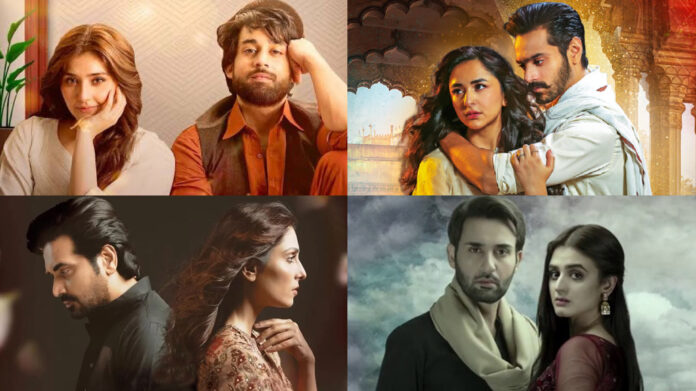
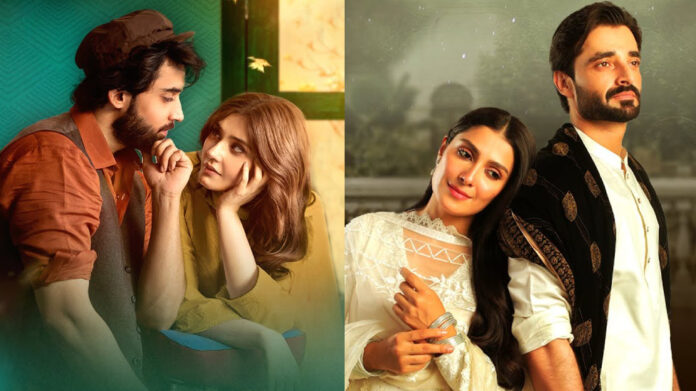
In the bustling landscape of Pakistani dramas, two contenders are stealing the spotlight ‘Jaan e Jahan’ and ‘Ishq Murshid’. Though their storylines differ, they both revolve around a familiar trope – a romance blossoming between a girl from a middle-class milieu and an affluent young man. Whether we agree with the repetition of these archetype plots, that’s a debate for another day. Till then, let’s explore the common ground that unites these two prominent dramas in the list of current dramas.

The feel-good romance takes us into the world of fantasy

Perhaps, the key to making a drama successful in Pakistan might lie in crafting a Cinderella love story that transports the audience into a world of fantasy. While ‘Ishq Murshid’ heavily revolves around the flourishing romance between Shahmeer Sikandar and Shibra, presenting a Cinderella love story, ‘Jaan e Jahan’ is somehow no different. While we will give these dramas that they are not the exact rip-off, but the baseline story remains the same.

In ‘Jaan e Jahan’ we have the evil mother-in-law who is already giving us vibes of how she is going to create trouble for Mahnoor in the near future, and while there aren’t evil sisters, there are certainly going to be evil brother-in-laws. It is given that the drama is able to craft a story that keeps us hooked while we know what’s to come; we await the drama as the central character Shehram fights for his position in this power play of gaining inheritance and power.

While there are no evil mothers and sisters is ‘Ishq Murshid’, who is stopping the leading lady Shibra from gaining her independence, but we do have the prince charming Shahmeer who is putting in all his efforts to make her fall in love. In fact, he even leaves his ‘palace’ and goes on to disguise as a man from a lower class to win her over.

The sizzling chemistry

When it comes to romance, the critical element to keeping it afloat undoubtedly lies in the chemistry between the actors. Both dramas are excelling in this department, with the lead stars skillfully developing a connection that captivates the audience.

In ‘Ishq Murshid’, Bilal Abbas and Durefishan Saleem leave us in awe as they share the screen. Bilal Abbas, portraying the loving and low-key hilarious Fazal Baksh, plays a significant role in creating this charming dynamic. Their chemistry is cute and evokes a feel-good vibe.

On the other hand, we have the ‘Pyarey Afzal’ duo, Ayeza Khan and Hamza Ali Abbasi, delivering a fiery chemistry that leaves us feeling giddy. The duo’s return after 10 years, following ‘Pyarey Afza’l, is a delightful surprise, showcasing that they still possess that irresistible charm that makes the audience fall for their chemistry.

Which of these two dramas are you currently watching and enjoying? Do let us know.

Unravelling Why ‘Grey’ Faces Low Viewership Despite Its Compelling Narrative

With 12 episodes already aired, the drama serial ‘Grey’ has us scratching our heads, wondering why it’s not pulling in the numbers it deserves. Centred around Salaar Khan, played by Sami Khan and Imaan Mansoor, played by Sabeena Farooq, the plot takes a gripping turn when Imaan accuses her co-star of harassment on national television. Amidst top-notch production quality and stellar performances, the drama goes beyond the traditional setup, promising an engaging storyline.

Despite these promising elements, ‘Grey’ seems to be struggling to capture the audience’s attention. Let’s unravel the mystery behind the low viewership, exploring the possible factors that might be hindering the drama from reaching its full potential.

What ‘Grey’ has to offer?

From day one, ‘Grey’ has offered something novel and unique. The drama marks the return of Sabeena Farooq after her hit serial ‘Kabli Pulao’ and introduces Sami Khan in a new avatar, making it safe to say the drama boasts star power that makes the audience curious to tune into the show.

Green Entertainment‘s new drama ‘Grey’, penned by Rida Bilal and directed by Sohail Javed, takes a different approach. It showcases different locations and a diverse supporting cast that contributes to its uniqueness, making it engaging.

Then, of course, the storyline is entertaining while focusing on a pivotal social issue. As discussed above, the drama is centred around exploring the story about finding out the truth and who is the culprit after a famous actor is accused of harassment. Many even linked it to the real-life case of Meesha Shafi and Ali Zafar, which might have been a pull for people to watch the show.

What’s good is that the drama focuses on both sides of the story. Even with 12 episodes in, we still can’t predict who is the real culprit and speaking the truth, keeping us captivated. As the audience, we get to see what both sides are going through, and there is also a focus on the supporting cast and the role of media in advancing propaganda.

Then, with all these factors, why is it still low on the rating charts?

Why is ‘Grey’ getting fewer views?

One plausible explanation is that for most people, watching television is a form of relief they seek at the end of the day, and having that comforting show is pivotal. So, in most cases, the established tropes and genres – in our case, a romantic love story weaving a narrative of a damsel in distress falling for a man – provide the archetypal storylines that viewers prefer. When new dramas are introduced that fall beyond the audience’s comfort zone, there’s an inherent reaction to give the new content a try, resulting in the beginning episodes getting relatively more views, but ultimately, people tend to switch back to what they enjoy watching.

Trying out new projects can be challenging, especially for viewers who may be hesitant to give unfamiliar shows a chance. It’s essential to acknowledge that Pakistani dramas have dominated the industry for years, establishing narrative formulas that consistently garner success. The industry tends to stick to these proven formulas to secure viewership and audience engagement. Shifting the trajectory of these narrative patterns is a complex process that involves a deeper understanding of audience preferences.

In essence, it’s unfortunate that ‘Grey’ is not receiving the viewership it deserves. Viewer ratings and reviews serve as crucial indicators for future content production, influencing the decisions of upcoming producers. The success of dramas plays a critical role in shaping the landscape of future projects. Making a switch to preferred content aligns with viewers’ interests and viewing habits.

Pakistani Veteran Actor Khalid Butt’s Demise Leaves Industry In Mourning

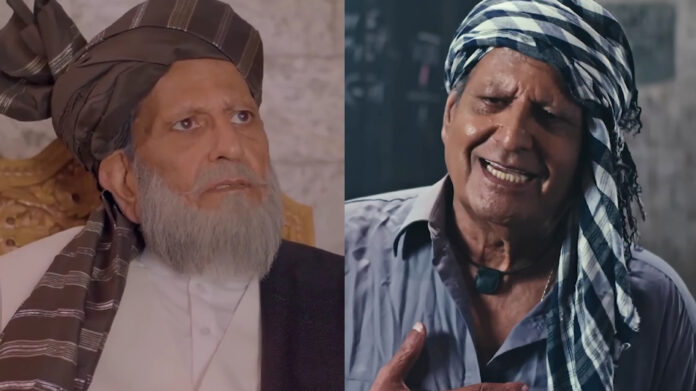
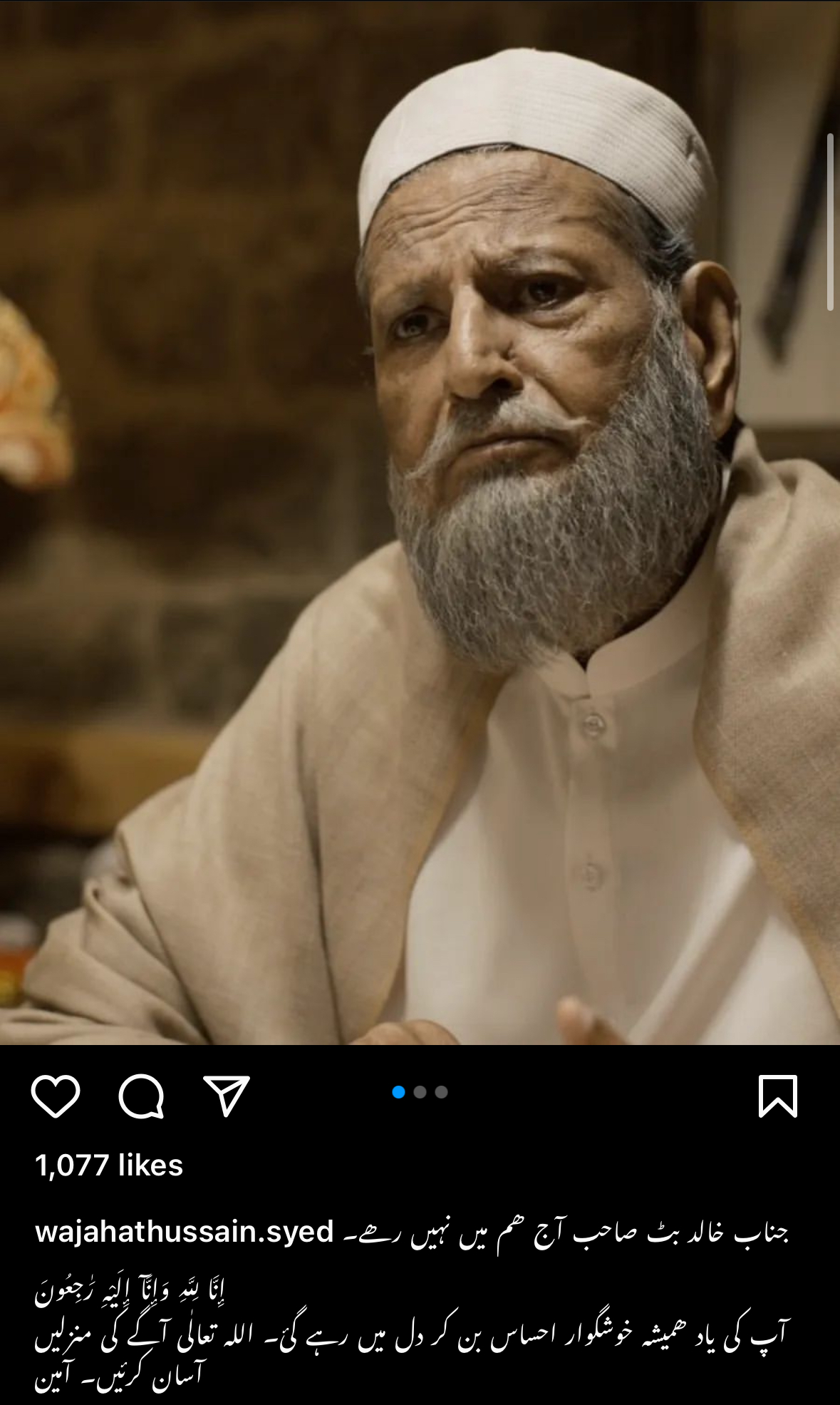
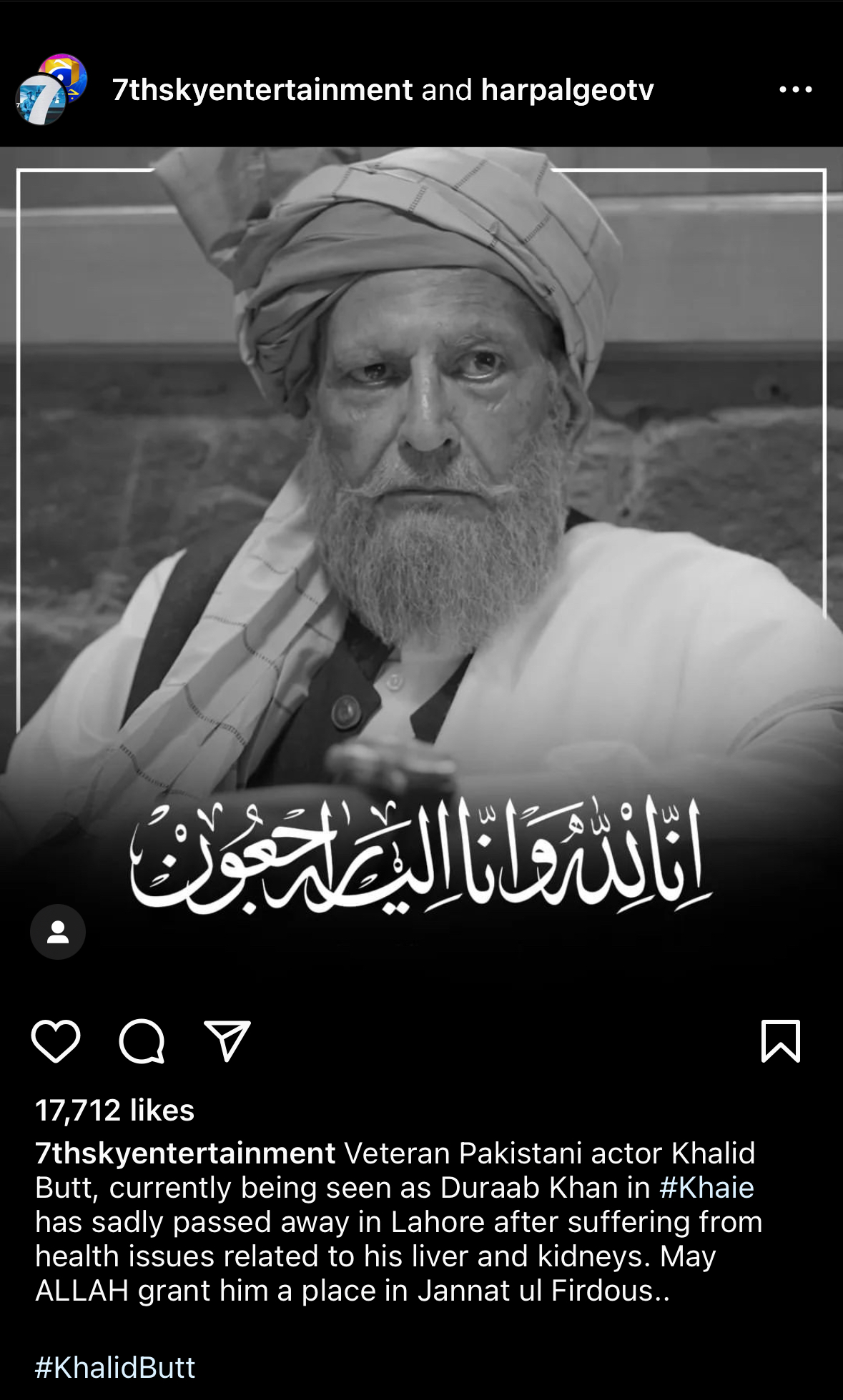
In a sombre turn of events, the Pakistani entertainment industry mourns the loss of a true icon as veteran actor Khalid Butt took his last breath on Thursday, 11th January 2024. The actor, revered for his timeless contributions, succumbed to complications arising from kidney and liver diseases.

Born in Multan, Khalid Butt’s artistic journey began in the 1970s, when he initially stepped into the world of entertainment as an assistant director — later transitioned to the role of a distinguished actor in 1978. Over the years, he graced the screens with his presence in numerous Urdu and Punjabi films, leaving an indelible mark on the industry. His versatility extended beyond acting, as he also ventured into film direction, showcasing his multifaceted talent.

The actor’s stellar contributions earned him the prestigious Pride of Performance award, a testament to his enduring impact on Pakistani cinema and television.

Khalid Butt’s legacy is imprinted in the hearts of his audience through memorable performances in iconic PTV productions. Notable dramas such as ‘Jangal Pura’ (1997), ‘Boota to Toba Tek Singh‘ (1999), and ‘Landa Bazaar’ (2002) showcased his acting prowess, garnering widespread appreciation from the public. Recent television dramas like ‘Jeevan Nagar’ and ‘Khaie‘ marked his triumphant return to the small screen.

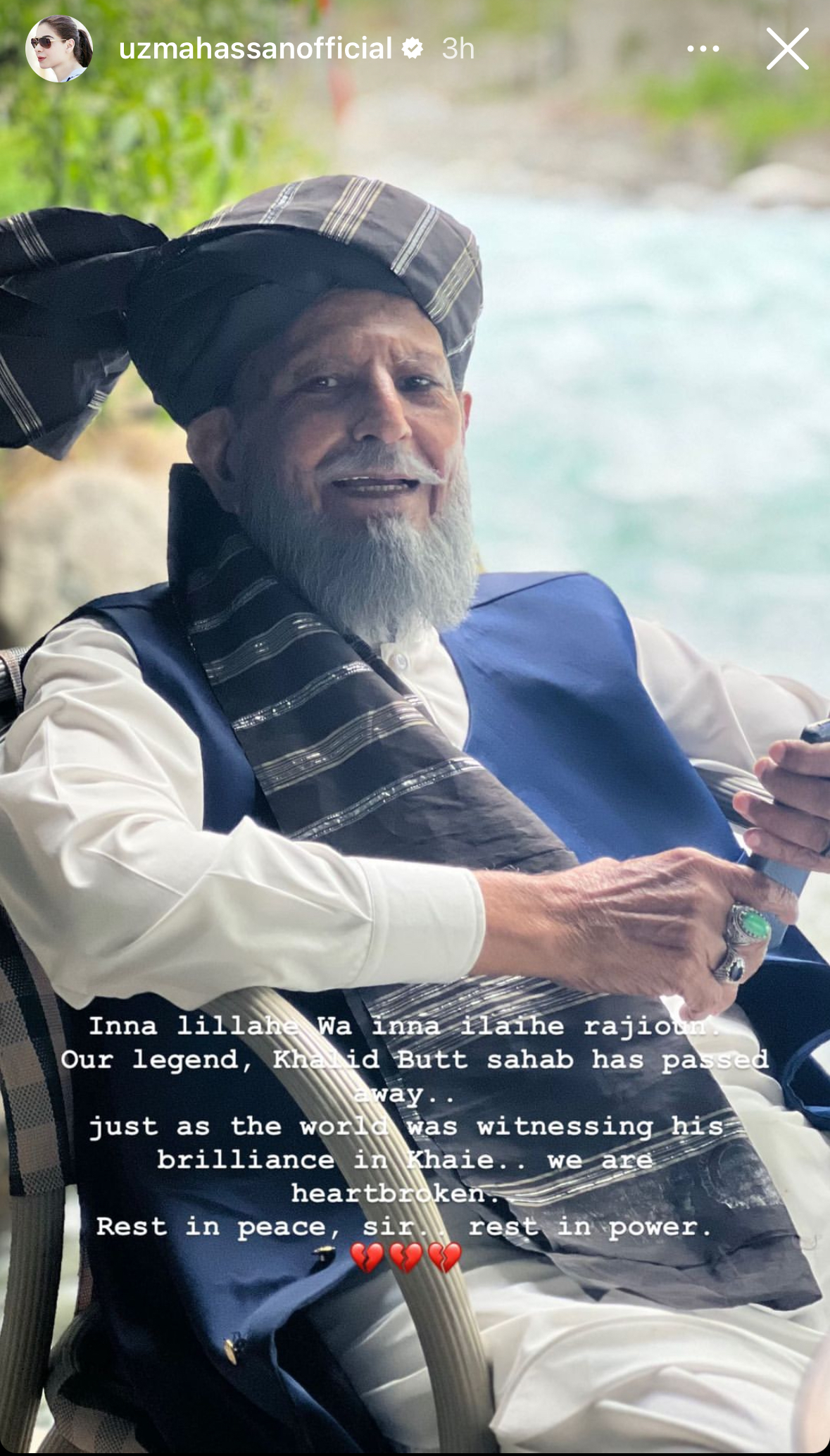
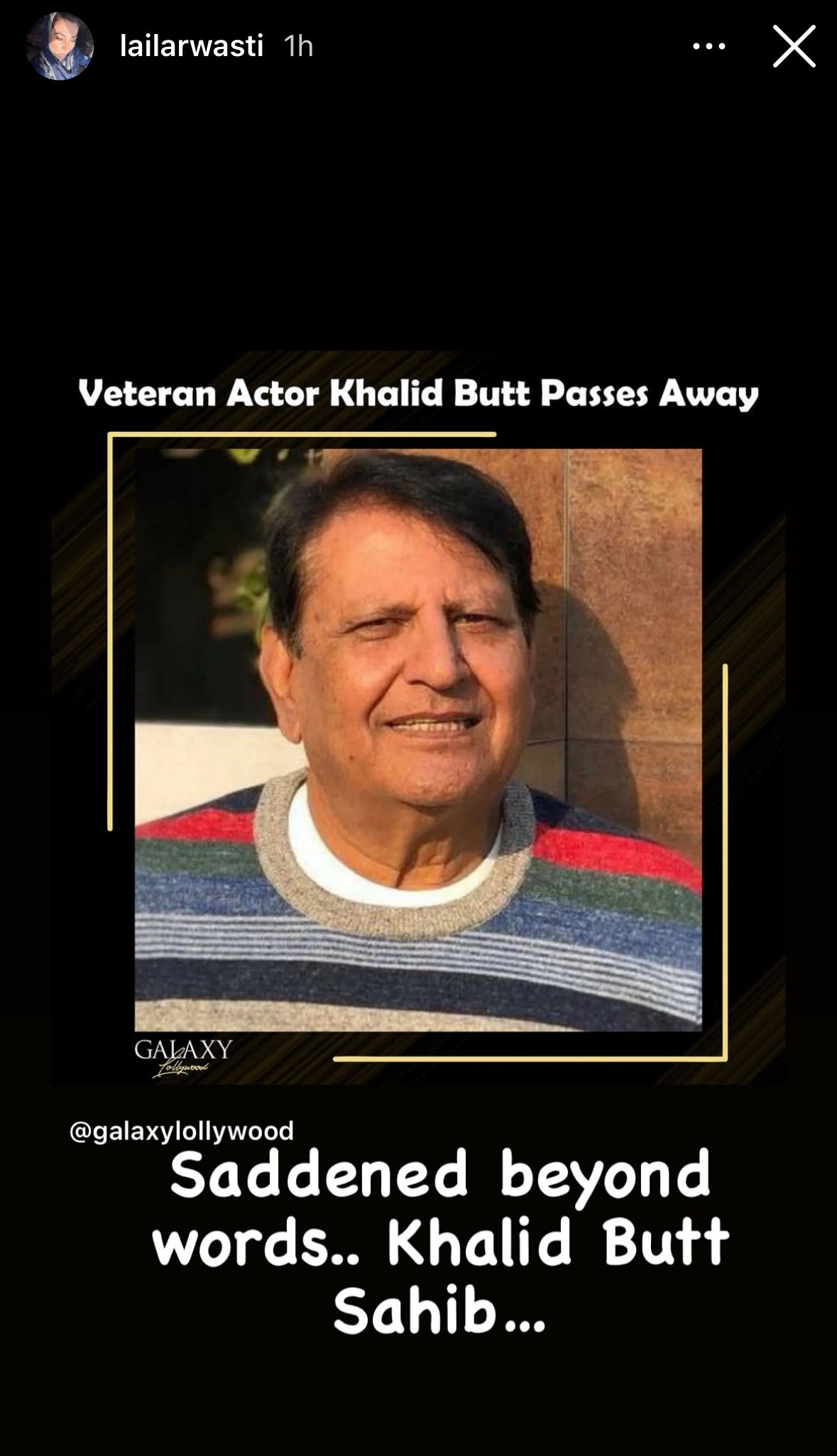
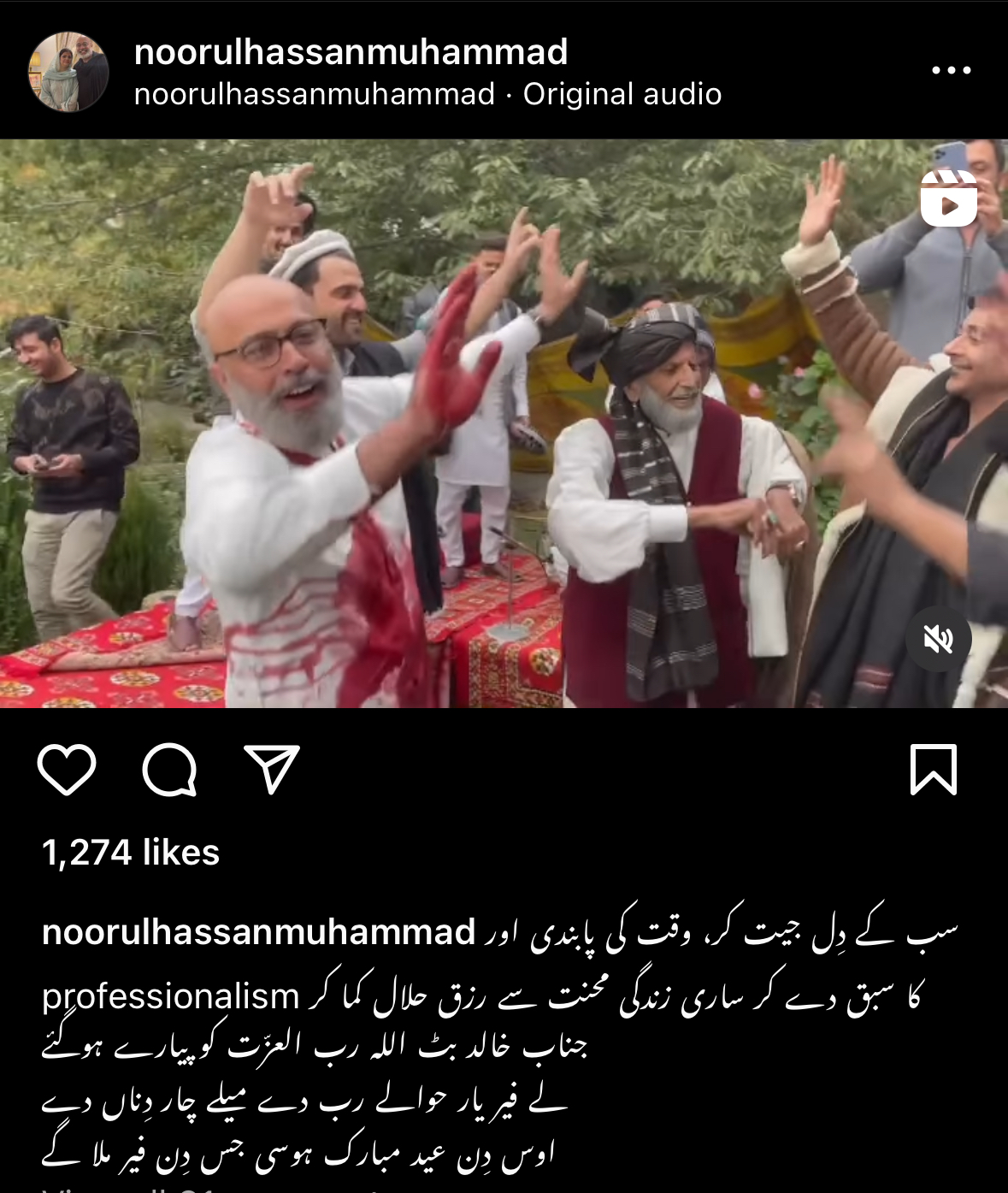
Remarkably, his final project, the ongoing drama serial ‘Khaie,’ featuring Faysal Quraishi and Durefishan Saleem, stands as a poignant reminder of his talent. Co-stars and friends, including Noor Ul Hassan, Faysal Qureshi, Uzma Hassan and Laila Wasti shared their grief on social media, expressing the profound impact Khalid Butt had on their lives.

In an Instagram post, Durefishan shared heartfelt sentiments, painting a vivid picture of Butt’s dedication to his craft even in the face of health challenges. His words echo the sentiments of all who had the privilege of working alongside this seasoned actor.

The director of the show ‘Khaie’, Syed Wajahat Hussain and production house 7th Sky Entertainment also posted about it on social media.

The news of Khalid Butt’s demise spread through the heartfelt announcement made by veteran PTV actor Mohsin Gillani on Instagram. The post, accompanied by Butt’s picture, carried a poignant caption that reverberated with the collective sadness felt by the industry: “Khalid Butt Passed Away/ خالد بٹ انتقال کر گئے.”

As we bid farewell to Khalid Butt, the void left by his departure serves as a stark reminder of the profound impact he made on Pakistani entertainment — a legacy that will endure through the characters he brought to life and the indelible mark he left on the hearts of his admirers.

Are Mesmerizing OSTs A Secret Ingredient Of Making Dramas Successful?

What makes a drama a classic or, if not that, then a hit? As we continue to watch Pakistani drama serials, one will instantly notice that most stories are forced into boxes that define them. But why do some of them instantly capture our attention, making us want to watch and rewatch them? Of course, it’s the star power, the direction, the dialogues, and sometimes a novel script. But the secret weapon that we don’t contribute enough to the success is the Original Soundtrack of our dramas.

OSTs play an essential role in cementing the drama as an audience favourite, and to say otherwise would be an understatement. They play an even more important role in this process. They make you feel for the characters and think more deeply about the story. As you hum the lyrics and enjoy the melody in your car or TV lounge, it subconsciously binds you to the drama you are watching.

You ask us what we call a great and memorable OST? Well, we say one, like any other good song, encapsulates you entirely and makes you groove alongside it. For a great OST, an additional checkbox is one that makes you think of the drama, making you revisit it again.

Take, for instance, the OST of ‘Humsafar’, which was composed by Waqar Ali and sung by Qurut-ul-Ain-Balouch in her soulful voice. As ‘Humsafar’ fans, we still sing the OST so often, and it remains one of the most popular OSTs in Pakistan, making us revisit the show and adding that nostalgic charm associated with the drama. Even the star of the show, Fawad Khan, couldn’t agree more, as in his recent interview he associated the drama’s success with its OST. Afterall, we can’t be the only ones who reminiscence Mahira Khan’s twirl in the rain as she dons the infamous black dress with the OST running in the background.

It would not be wrong to say that OSTs are like the heartbeat of a drama. Each lyric and every note becomes a vessel carrying the essence of the characters’ joys, sorrows, and triumphs. The sensational drama ‘Tere Bin’ stands as a testament to this truth with its impactful OST. The energetic tone of the music injects vitality, and the drama’s lyrics sparked discussions, notably the line “kya hoti hai bewafai tujhe karki dekha doon ga” [what is betrayal, I will show it to you]. This lyrical choice became a topic of conversation, reflecting how the drama’s success prompted engaging discussions surrounding its themes.

A prime example of an impactful OST that has significantly contributed to shaping the ambience of a drama is the one belonging to ‘Ishq Murshid’ sung and composed by Ahmed Jahanzeb. Instantaneously transporting the audience into a fantastical realm, this OST, currently boasting nearly 50 million views, enhances the overall appeal of the drama. The lyrical content of the OST seamlessly adds to the enchanting atmosphere crafted by the director.

In the case of the drama series ‘Kabli Pulao’ the credit for the show’s success undoubtedly goes to its OST. Owing to its OST, which was sung by the maestro Rahat Fateh Ali Khan, the drama garnered popularity even before its release, sparking intrigue among the audience about the unfolding story. The OST titled ‘Ankhain‘ skillfully weaved a captivating mystique, leaving viewers in suspense about the plot. Notably, ‘Kabli Pulao’ emerged as one of the standout projects of 2023, receiving acclaim from both audiences and critics alike.

Wielding new trends

In a recent development in the realm of drama and OST trends, a notable trend has emerged involving the incorporation of immensely popular songs as OSTs, essentially shaping the drama around these musical compositions. This innovative approach became evident in the drama ‘Mujhe Pyaar Hua Tha’, which adopted the widely acclaimed song ‘Kahani Suno 2.0’ by Kaifi Khalil as its OST. The drama garnered immediate attention, attracting viewers who were intrigued by the unique integration of the celebrated song into the project.

This trend continued with the current drama ‘Sukoon’ which followed a similar pattern. The OST was released prior to the drama’s airing and prominently featured Hassan & Roshaan’s song, featuring Shae Gill, titled ‘Sukoon’. Intriguingly, the makers opted to name the drama after the same song, creating a seamless connection between the musical composition and the overall narrative. This strategic use of popular songs as integral components of drama OSTs reflects a creative and engaging approach that captures audience interest from the outset.

Looking back at the iconic hits

The enchanting melodies of Pakistani dramas have left an indelible mark on viewers, becoming synonymous with the success and popularity of these iconic shows. One such example is the soul-stirring OST of ‘Khaani’, composed by Sahir Ali Bagga and melodiously rendered by the maestro of Qawali, Rahat Fateh Ali Khan. This rendition is a poignant portrayal of pain and heartbreak, with lyrics that vividly capture the tumultuous emotions spurred by love.

Among the timeless classics, the original soundtrack of ‘Khuda Aur Muhabbat’ stands out as a fan favourite, sung by the talented Ahmed Jahanzeb and penned by Javeria Saud. Across multiple seasons, the singers have masterfully done justice to the soundtrack, but the original rendition holds a special place, emanating a sense of peace and tranquillity that resonates deeply with the listener.

The year 2020 witnessed the rise of the iconic drama ‘Meray Paas Tum Ho’ and its soundtrack, penned by the scriptwriter Khalil-ur-Rehman Qamar and performed by Rahat Fateh Ali Khan, added to its allure. The slow, melodic composition beautifully encapsulates the pain and agony of a broken heart, contributing to the drama’s immense success.

Not to be forgotten is the unforgettable phrase “ja tujhe maaf kiya” [go, I forgive you] from the soundtrack of ‘Do Bol’. Sung by Nabeel Shaukat and Aima Baig, this romantic melody became a sensation, winning the hearts of millions of viewers and establishing the drama as a hit with its captivating and timeless appeal. These dramas, accompanied by their soulful soundtracks, not only garnered immense love but also achieved remarkable viewership, solidifying their status as unforgettable hits in the landscape of Pakistani entertainment.

Solidifying the assumption, we have observed over the years, OSTs play a significant role in shaping the success of a drama. While it is not the sole factor directing a drama’s success, it contributes to connecting the audience with the storyline, adding enjoyment to their viewing experience, and prompting them to reminisce about iconic scenes.

Akhara’s First Episode: Wrestling Drama’s Vibrant World And Dynamic Cast Shine

Green Entertainment has made a significant effort since its launch in July last year to try and tell fresh and diverse stories. The channel has already made a name for itself for tackling important topics and bringing exciting new stories which we haven’t seen much of in the past.

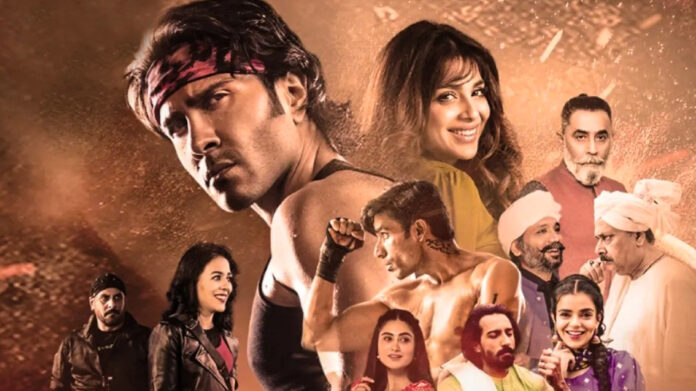
Akhara’ is the latest entry in their stellar portfolio. A rich tapestry set in the testosterone world of wrestlers; we were highly anticipating it from the moment we saw the trailers. A story about vengeance and power dynamics set on the backdrop of an akhara, filled with buff men all around, who wouldn’t be excited. Penned by Shahid Dogar, directed by Anjum Shahzad and produced by Multiverse Entertainment.

So, how did the first episode fare? Let’s see.

The Story & Cast

As mentioned above, the story is set against the backdrop of an akhara where Waseem Abbas plays a former wrestler who now serves as a trainer for his wrestler son Sultan, played by Faraz Farooqui.

Feroze Khan plays Sultan’s younger brother Dilsher. This role feels all over the place with the writing. The episode opens with Dilsher seeming like a mama’s boy who has no interest or skill to be involved with his family’s wrestling lifestyle.

He is seen being babied by his mother, played by Nida Mumtaz and his twin sister, played by Hina Afridi. However, at one point, his character seems to take a complete turn as he showcases his hot-tempered attitude which feels out of character after what we had established.

This doesn’t stop there, as in the next few scenes he’s back to being the carefree guy he is. It also doesn’t help Feroze’s case that Faraz Farooqui fits so perfectly into his role as Sultan. The actor not only looks the part and has done the physical work for it but is also incredibly charming and endearing in the romantic interactions with his fiancé played by Searha Asghar.

In Feroze’s defense, the trailers hint at a major turning point for his character which will set him on the path of vengeance, but in this debut episode, the character seems the most pointless to the story considering he is the lead.

This first episode primarily focuses on father and son Waseem Abbas and Faraz Farooqui and their rivalry with fellow wrestler Dastgir and his benefactor Chaudhry Sahab, a landlord played by Nazar ul Hassan. Chaudhry also has a son Rustam, played by Kashif Hussain. Rustam is a hot-tempered man who lives in the city for his studies.

This is where we get to meet Sonya Hussain’s Satara, who has barely anything to do in the episode besides setting up Rustam’s character. Rustam is introduced to us in a rather overdramatic action scene, as he rescues Satara from a guy at their university who’s harassing her.

Cast Performances

Waseem Abbas and Faraz Farooqui steal the episode. Both are completely lost in their respective roles and bring a level of authenticity that is needed for the world-building of this show. Nazar ul Hassan also stands out as a puny and vengeful man who clearly has a history with Waseem Abbas’ character that is yet to be revealed.

Feroze Khan is as good as ever here but is brought down a little due to choppy writing for his character. Hopefully, as the story progresses, his character comes into focus.

Nida Mumtaz has some key scenes near the end of the episode, as she plays a concerned mother trying to stop this violence before it goes too far. These scenes are also clear foreshadowing for what’s to come as her concerns are dismissed by her family.

Hina Afridi as Ramsha is also great. She and Feroze Khan get to play a very fun and loving sibling dynamic throughout the episode. Srha Asghar plays a firecracker as Sultan’s fiancé and is the only person who keeps him on his toes, creating an adorable dynamic.

Stellar World-building

The world-building in this show is already stellar. You feel instantly transported to this world of akharas and wrestlers. The show’s use of wrestling commentator’s announcements also adds to the vibe of the show.

All the wrestlers featured in the show also seem authentic and those scenes are easily the most fun to watch, as these are things we don’t always see on the small screen, certainly not in our shows.

So, while ‘Akhara’ does weirdly overshadow its two leads in the pilot episode, it does showcase incredible world-building and some great set pieces that are sure to feature action scenes in later episodes. The episode also has great performances from the likes of Waseem Abbas, Faraz Farooqui and Nida Mumtaz.

The show certainly needs another episode or two for its story and characters to fully come into focus, but it is already firing on all cylinders with the titular Akhara.

Taxali Gate’s Trailer Unveils Abu Aleeha’s Directorial Evolution

Abu Aleeha stands out as a beacon of resilience in Pakistan’s cinematic landscape, advocating for the weekly film ritual to breathe life into the country’s theatres. Often labelled a ‘low-budget’ wizard, Aleeha crafts cinematic wonders every 3-4 months, fearlessly exploring horror, horror-comedy, and crime thriller genres. With an impressive repertoire of 12 movies, including the upcoming ‘Taxali Gate‘, his journey hasn’t been without its bumps, with films like ‘Udham Patakh‘, ‘Lock Down‘ and others not hitting the jackpot. Yet, Aleeha remains undeterred, proving that setbacks are mere detours on the road to success.

From Horror to Comedy and Crime Thriller: A Cinematic Journey of Resilience

Last year marked a cinematic evolution for Aleeha, with ‘Javed Iqbal‘ and ‘Super Punjabi‘ gracing the silver screen and coming out as a better version of his directorial career. ‘Javed Iqbal‘, though uniquely narrated, sought balance, falling short in screenplay and script vibrancy. Yet, Aleeha’s resilience shines through, and the dawn of a new year hints at a potential turning point for this dedicated director. The recent unveiling of ‘Taxali Gate”s trailer has us all applauding Aleeha’s craft, sparking hope for a cinematic fate change in the cards for this hardworking maestro.

The movie’s trailer graces the screen like a cinematic symphony, leaving spectators in sheer awe, uttering a collective ‘Just Wow’ anticipation hangs thick in the air. Will this be the harmonious blend of narrative, screenplay, and execution that fans and cinephiles have been eagerly awaiting?

Taxali Gate: The WOW trailer

The trailer, a canvas painted with myriad emotions, offers a tantalizing glimpse into the clandestine world of a Lahore brothel house. The very name, Taxali Gate, evokes curiosity, being a passageway to Hera Mandi. Cinematic shots, delivered with prowess by a stellar cast, create an irresistible allure for cinema enthusiasts.

Ayesha Omer’s Cinematic Prelude: A Symphony of Solid Expression

The overture unfolds with a captivating shot of Ayesha Omer, a cinematic enchantress whose solid expression and compelling dialogue resonate with the audience. The trailer, intricately woven around Omer’s dialogue, acts as a mesmerizing prelude, ensuring the audience is irresistibly drawn into the unfolding narrative.

Along with Ayesha as a lead, the cinematic magic is amplified by the powerhouse performances of Yasir Hussain, Mehar Bano, Umer Aalam, Iffat Omar, and Nayyer Ejaz.

Beyond its narrative, ‘Taxali Gate”s trailer is a sensory feast, incorporating a powerful musical element. Eva B, with her dynamic rapping style in ‘Haq Kidher Hai’?, adds another layer to the cinematic experience. This creative marriage of music and storytelling enhances the trailer’s allure, promising an immersive cinematic journey.

In the realm of filmmaking, Abu Aleeha emerges as a beacon of resilience and creative fervour. ‘Taxali Gate”s trailer not only showcases his dedication to improvement but also instils hope in audiences, reaffirming their faith in the vibrancy of Pakistani cinema. The film is all set to hit cinema screens worldwide on 16th Feb.

Mahira Khan Pays Tribute To Bollywood’s Parveen Babi, But What About Our Pakistani Icons?

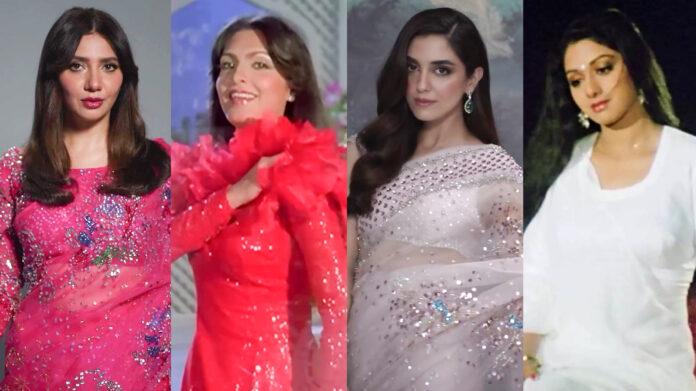
Mahira Khan never fails to surprise, effortlessly dropping captivating bombs with each move, keeping her fans on edge, eagerly anticipating her next steps. Collaborating with a clothing brand for a tribute to Indian icon Parveen Babi is her latest endeavour, following Maya Ali’s homage to Sridevi. While these tributes were appreciated, it was natural for us to ask where are the salutes to our Pakistani legends? As we unwrap this debate, let’s see what our celebrities had in store for us.

Mahira Khan impresses as she pays tribute to Parveen Babi

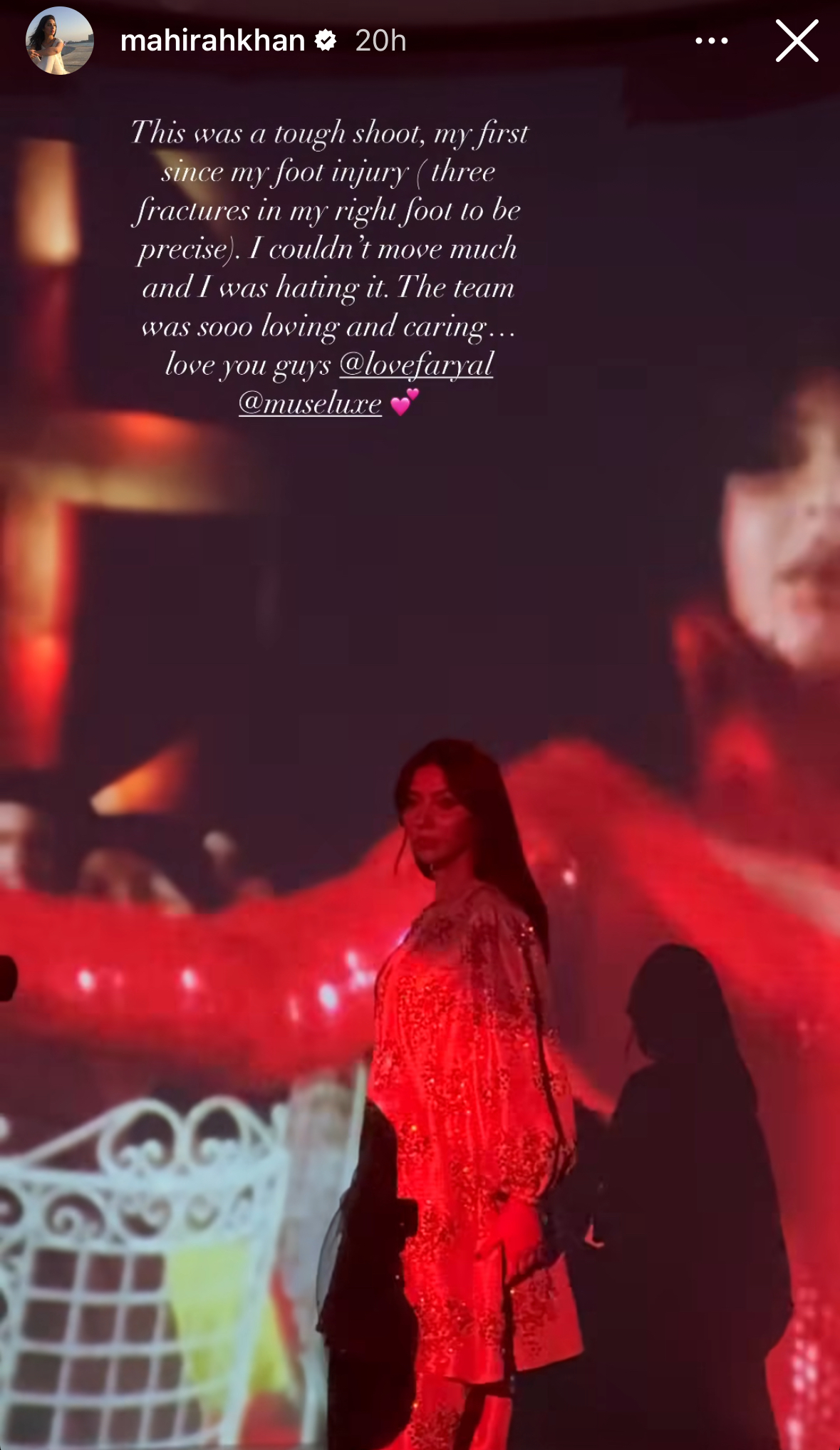
Mahira Khan dazzles us yet again, proving she’s not just a star but an icon in her own right. In a stunning tribute to the late Indian legend, Parveen Babi, Mahira wowed hearts, nailing her look in a recent clothing brand shoot. But behind those glamorous shots, Khan shared her backstage story on Instagram – and it wasn’t all glam! “This was a tough shoot, my first since my foot injury (three fractures in my right foot to be precise). I couldn’t move much and I was hating it. The team was so loving and caring,” she revealed.

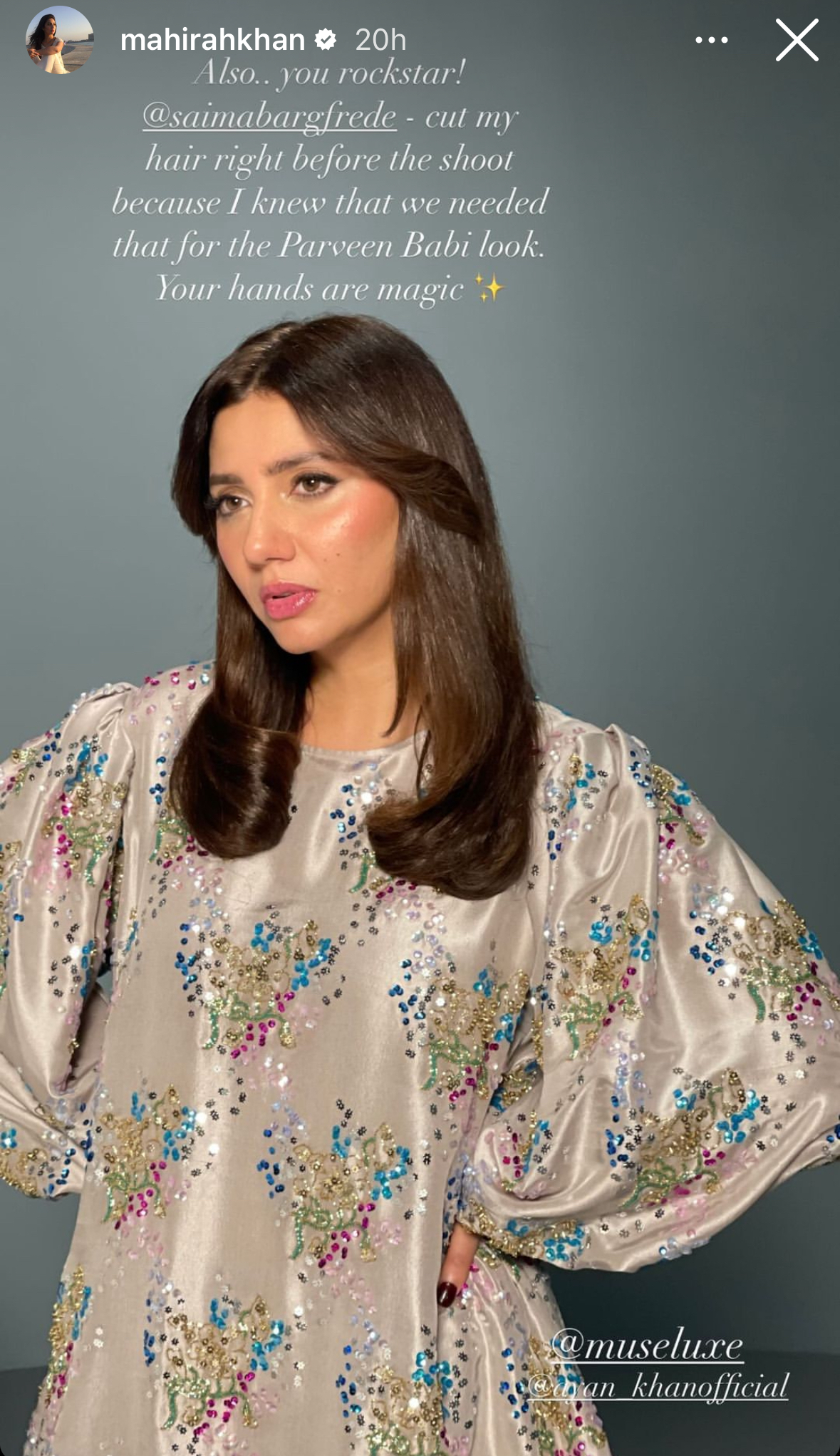
But that’s not all! Mahira went all-in to perfectly embody the iconic Babi. She even got a haircut just like Parveen Babi’s for that extra touch! With a shoutout to her stylist, she playfully wrote, “Also..you rockstar! (tagging the artist)-cut my hair right before the shoot because I knew that we needed that for the Parveen Babi look. Your hands are magic.”

Mahira donned a shimmery rani pink saree, channelling the legendary Parveen Babi’s glamorous vibes. But wait, it gets better. This Bollywood-inspired shoot wasn’t just about dressing up. The spontaneous haircut coupled with Mahira’s graceful moves as she groves to the late icon’s song was a treat to watch.

When asked about her inspiration, Mahira’s eyes sparkled with nostalgia as she recalled discovering Parveen Babi through a Time magazine cover. She spilt the beans, saying, “I remember seeing this Time magazine cover and it had the gorgeous Parveen Babi on it. It’s because of that cover that I actually watched her films. Some of her songs I just love. She was so beautiful, such a style icon.”

In another captivating segment, Mahira’s silver kurta ensemble stood against a backdrop projecting Parveen Babi’s legendary song, setting the scene as Mahira grooved.

Regarded as a fashion icon and perhaps one of the most celebrated and finest actresses of Indian cinema, Parveen Babi left a lasting impact that was cemented through her performances and charisma.

Stunning Maya Ali’s tribute to Sridevi in a blush sari

A few months back, Maya Ali collaborated with the same brand, donning a sparkling light-pink sari. Accentuating her stunning attire, she adorned herself with silver and emerald green dangling earrings. For her makeup, she opted for a delightful blush-pink appearance. The ‘Mann Mayal’ star flaunted her dance moves, captivatingly grooving to one of Sridevi’s iconic movie songs. Alongside her dazzling performance, she expressed her admiration for the late Indian actress in a heartfelt note, “I’ve always cherished revisiting the most impactful films, and when I laid eyes on this shimmering blush sari for my role, it was pure love. After rehearsing my part, I knew this was the outfit I wanted to wear.”

Why tribute to only Indian actors

While these photoshoots took us on a nostalgic trip, witnessing our actresses channelling their inner heroines while paying homage to these two legendary stars, it raises a pertinent question. In the current climate of hostility between India and Pakistan, coupled with a restricted content exchange, one might ponder the appropriateness of honouring Indian stars. Moreover, it prompts us to address the elephant in the room: Why do we seemingly overlook paying homage to our homegrown icons and legendary stars who have laid the foundation for Pakistani cinema and television, contributing immensely to their growth? When will we prioritize honouring our own?

Picture this: our very own glamourous Sajal Aly pays a tribute to the iconic singer and pop queen of Pakistan, Nazia Hassan. We could get a playful collaboration between Sajal Aly and actor Sheheryar Munawar as they recreate memorable pictures of brother-sister duo Nazia Hassan and Zoheb Hassan for a photoshoot. What could be better than seeing Sajal Aly recreating Nazia Hassan’s look and adding that playful charm?

Or imagine the current Pakistani television industry’s ‘IT’ couple, Wahaj Ali and Yumna Zaidi paying an ode to the power couple Rahat and Sahira Kazmi. What could be better than going back in time and reminiscing a time when both the stars paved a name for themselves in the entertainment industry of Pakistan and gave it its gems such as the likes of drama ‘Dhoop Kinaray’.

While our dearest Mahira Khan was perfect in portraying Parveen Babi, we cannot help but think if that star power and dedication was spent in recreating celebrated looks of Pakistani film star Babra Sharif from her renowned films like ‘Mera Naam Hai Mohabbat’ or ‘Shabana’.

There is no doubt that cross-culture collaborations and celebrations of culture and artists pave the way for harmony and respect across borders and it is always encouraged. Nevertheless, it’s pertinent to not forget local legends in the process who deserve recognition and appreciation for their contributions. Let’s not forget the likes of Marina Khan and Vaneeza Ahmed who are our nation’s Meryl Streep and Rekha. Their enduring legacy in our industry deserves royal treatment, acknowledging their eminence as the queens they are.

5 Reasons Why We Want To See Fawad Khan In Popcorn Flicks

Popcorn flicks are the backbone of any film industry. They are family-friendly entertainment and get audiences to come to the theatres in droves and generate massive business for cinema houses and the entertainment industry. Popcorn films are movies without any dramatic content or message, simply serving as entertainment for the audience.

These films are often action-adventure films, comedies or romcoms and sometimes all of the above. They include something for everyone to enjoy, hence being major crowd-pleasers. They also function as star vehicles, allowing actors to let loose and have fun while also proving their might at the box office.

Fawad Khan appeared on Ahmad Ali Butt’s podcast ‘Excuse Me’ and the actor gave us a lot of insight into what he wants for his career going forward and how he has gone with the flow so far. During this interview, the ‘The Legend of Maula Jutt’ revealed that he was tired of intense dramatic roles and wanted to pivot towards more fun popcorn flicks.

Since the superstar himself is so eager to do more popcorn flicks, we compiled a list of 5 reasons why we want to see Fawad Khan in popcorn flicks.

Fawad Is Eager To Do Them

The main reason we want to see Fawad Khan in popcorn films is because Fawad Khan wants to see himself in them. The actor went into detail during the podcast interview about how he feels exhausted after performing in highly dramatized roles.

‘I don’t want to do the emotionally heavy stuff.’ said the ‘Humsafar’ actor.

He also went on to say ‘I would rather play comedies, I would love to do action…just do stuff that is no frills no emotional drama’

So, since the actor himself is craving such projects and the industry needs these blockbusters, let’s keep going and give him more popcorn films to work on.

Already A Proven Action Star

Most popcorn films and summer blockbusters have some degree of action in them. So, who better to do it than the star of the biggest Pakistani action film of all time? Khan underwent a rigorous process to prepare for the role of the action hero Maula Jutt and he can bring that training to any future project he has.

We would love to see Fawad in an action-packed film where he also gets to be more comedic this time around.

Great At Comedy

While Fawad’s breakout roles were in the film ‘Khuda Kay Liye’ and the megahit show ‘Humsafar’ those were not his first acting roles. Khan started acting in the sitcom ‘Jutt and Bond’ where he played a satirical version of James Bond. Khan made a return to comedy in his Bollywood debut alongside Sonam Kapoor in ‘Khoobsurat’ which was a hit.

It is worth noting that Khan’s last film was partially a comedy named ‘Money Back Guarantee’, which was critically panned and failed to make a mark last year. Hopefully, Khan will choose better projects and collaborators for such future roles, particularly better comedic writers.

Stellar Chemistry With Co-stars

Whether it’s his male scene partners or female love interests, Khan always has amazing chemistry with all his co-stars. This is key for adventure films and blockbusters where the script or character work is not of priority but it’s the cast and their dynamics amidst the campy settings. So, you need a star at the forefront to carry a film like that and the whole cast with him.

Coming back to ‘Khoobsurat,’ Fawad also proved that he wasn’t just good at romance in serious dramas but also in romcoms and that’s always a necessary element of any summer blockbuster.

A Big Screen Star

It’s no surprise to hear Fawad be called a big-screen movie star but what that entails is that he can make people watch almost anything he is in. He effortlessly commands attention whenever he graces the screen — not to forget. ‘Ae Dil Hai Mushkil’, a film where even Ranbir Kapoor’s fans found it hard not to be captivated by the magnetic presence of Fawad Khan. There’s a reason that movie stars are so valuable to blockbusters, because an all-ages entertainer paired with an actor with a huge demand is a match made in box office heaven.

So, with all the reasons listed above we are just as eager as Fawad himself to see him in more such projects.

Agha Ali Spills The Beans On His ‘Not-So-Good’ Reputation With Actresses’ Fiancés

Agha Ali recently made an appearance on Tabish Hashmi’s talk show, Hasna Mana Hai, where the discussion took an interesting turn to explore the actor’s “good looks” and their impact. Hashmi playfully delved into tales of Agha’s past, particularly a time when actresses allegedly hesitated to work with him due to their partners’ perceived discomfort.

Hashmi probed into the actor’s reputation, asking about the reasons behind it. “Why was your reputation so bad?” quizzed Hashmi. “No, no. Seriously. I heard you and the producers would also have a laugh about it,” he added.

Agha responded saying, “Back in 2016-17, just before I was about to shoot a drama, the producers would ring me up, questioning if I had any issues with the leading lady. I’d be baffled, having never even met her. Then they’d ask me whether I have a scuffle with their fiancé. I wouldn’t even know the fiancé so why would I have a scuffle? Turns out, he wasn’t keen on her working with me because he was, well, scared,” Agha shared, injecting a touch of laughter.

The actor humorously disclosed that he once took matters into his own hands and actually spoke to two co-stars’ fiancés. “There was this leading lady, a well-known actor, dating another actor. Humayun [Saeed] bhai was the producer of that drama. So, one day he asks me, ‘Agha, what did you do to make this guy so insecure?'” Agha narrated, with Hashmi injecting more humour into the narrative.“And Humayun bhai was asking this…” Agha laughed and said, “But we had a good laugh about this,” continued the actor. “And I told him that if his production house was suffering because of me then I would step back, maybe sign a different drama.”

Agha said, “See, I think, the characters you play, they form this… perception of you. And when I had newly started working, I didn’t attend any parties, I wouldn’t socialize and I would play these characters so people thought, that’s who I am. That’s the only image they had of me. That role I’d play onscreen.”

Agha wrapped up the banter with a touch of wisdom, stating, “Maybe they saw something special in me (switching to Ali Zafar’s voice)… but let’s be clear, no one should feel threatened by anyone!”

The narrative has left the audience amused and intrigued about who these actresses and their partners were.