Home Blog Page 22

Is Ayeza Khan Doing Justice to Her Character in Mein?

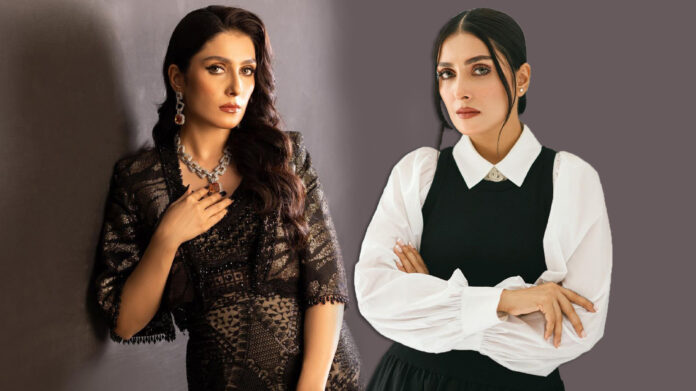
Ayeza Khan in Mein

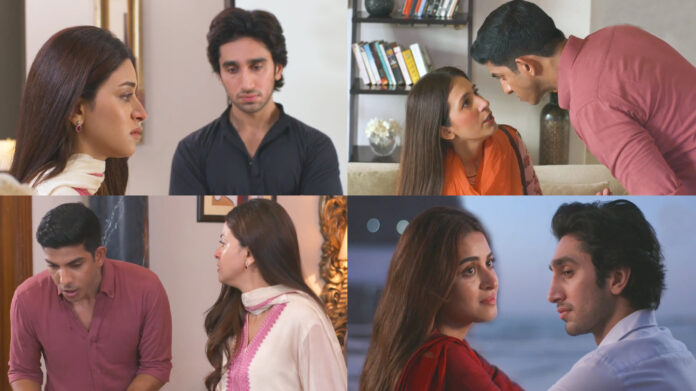
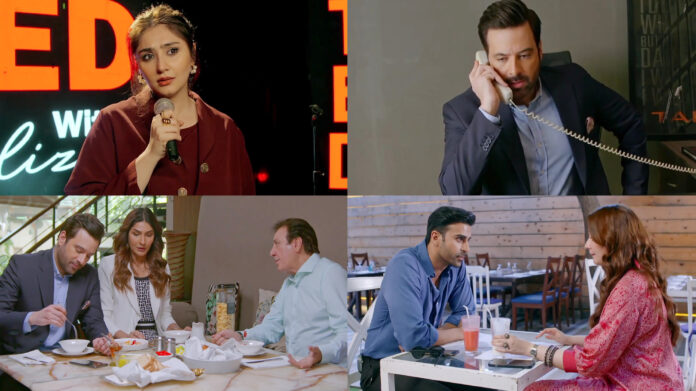
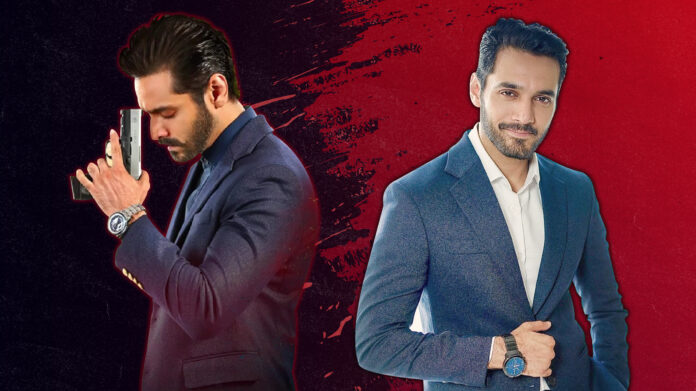
The latest television series on the scene, Mein, featuring the dynamic duo of Wahaj Ali and Ayeza Khan, has sparked widespread discussions since the release of the first episode. By bringing together the nation’s heartthrob Wahaj Ali, with the stunning Ayeza Khan, alongside a distinctive storyline, and grand-scale production, the show has managed to capture a significant viewership and has created a buzz on social media.

Ayeza Khan essays the character of Mubashira, an arrogant, wealthy woman, who is self-centered and has a stubborn nature. She refuses to surrender and clings firmly to her ego. Mein orbits around Mubashira and her journey of overcoming heartbreak and her battle against her own ego, after she is divorced by her husband at a party, celebrating their second wedding anniversary.

Audience’s reaction to Ayeza Khan’s portrayal of Mubashira:

Ayeza Khan has received mixed reactions from the audience for her performance in Mein. While some praise the actress for her portrayal of a cold-hearted woman and her expressions, others are skeptical of her performance and are critical of her ability to embody the role of a rich girl.

So, what has worked for her and what didn’t?

It is without a doubt that Ayeza Khan is channeling her experience as an actress and bringing her skill and polished craft to the sets of Mein. She is comfortable in performing dramatic scenes and is experimental with her acting, which is due to her confidence as an experienced actor.

Her performance in some scenes was commendable, especially in the scene where she talked to her father about her heartbreak and how she was left distorted after the betrayal of her husband and childhood best friend.

On the other hand, unfortunately Ayeza Khan has gone overboard in some of her scenes in the drama and thus is not able to convince the audience with her acting skills.

The wardrobe dilemma:

Ayeza Khan is one of the most celebrated models of our country and certainly has clothes from the top designers at her disposal and has the liberty to choose from. We have seen the actress opting for a unique wardrobe for each of her dramas, that distinguishes her character. However, in Mein, her styling is poor, and the outfits are not appropriate for the occasion.

Moreover, her iconic black dress which she wore for the anniversary party received a lot of criticism for its unflattering fitting on Ayeza. This has unfortunately taken away from her performance.

A ray of hope?

Ayeza Khan is indeed one of the most talented actresses in our country. She has given mega hits over the years including Meray Paas Tum Ho, Pyarey Afzal, and Chupke Chupke among others. She has selectively and carefully chosen her projects over the years and has delivered.

We do hope that in the coming episodes Ayeza’s character grows on us. We also anticipate more interaction between Wahaj and Ayeza in the drama. Let’s hope for fans and critics to cumulatively praise the craft of the leading cast in Mein.

Unveiling Romance and Drama: Sirf Tum Concludes on a High Note

Sirf Tum Drama End

For a month the audience embarked on a journey with characters from the drama serial Sirf Tum. With many twists and turns in the characters’ lives, Sirf Tum was successfully able to keep the audience hooked and captivated.

Written by Seema Munaf and directed by Mazhar Moin, Sirf Tum is a signature style 7th Sky Entertainment production with larger-than-life frames, a jaw dropping set, and of course a sizzling on-screen pairing. The drama concluded with forty-eight episodes of dramatic turns, conflicts, and chaos that all settled with a dreamy and romantic beach scene in the last scene of the last episode.

Let’s dive straight to the last episode and see how the drama concluded.

★spoilers ahead.

An Ending For The Audience

The last episode begins with Abeer firmly standing on her decision to go to America. She expresses her love for Hannan to Hamza, who keeps on agitating her and pushing her to leave Hannan and marry her.

The episode moves forward as tension rises in the household with Abeer leaving. Hannan is devastated and after finding no other choice, he turns to Sara for help so that she can clear the misunderstandings between Hannan and Abeer. Hamza, who is desperate to create more confusion between Hannan and Abeer, overhears their conversation and reaches Sara’s house before she can leave for the airport to clear things out with Abeer.

In a dramatic turn of events, Hamza and Abeer-who is going to the airport-both end up at Sara’s place. Hamza aggressively tries to manipulate Sara and tries to stop her from going to the airport. However, Abeer overhears their conversation of how Hamza influenced Sara to create misunderstandings between Abeer and Hannan.

After Hamza loses his cool, Abeer comes to Sara’s rescue and takes her to the hospital. Sara attempts to patch things between Hannan and Abeer and reassures Abeer that she should be with Hannan, who loves her, and Sara tells Abeer that she is getting engaged.

After some more dramatic scenes that followed due to Hamza’s aggressive reaction to Abeer and Hannan reuniting, we finally get to see the lead pair together on the beach, sharing some romantic moments with a mesmerizing backdrop.

Fans were over the moon to see Abeer and Hannan reunited, and the last episode not only garnered more than 4 million views in less than 20 hours of the release of the episode but also received positive feedback from the audience in general.

What Worked for Sirf Tum?  

The views and the applause that Sirf Tum received are a testament to its success. Although the drama had a total of forty-eight episodes, the fact that it concluded within a month, and was not stretched any further, really helped in keeping the drama’s rage alive, as it did not agitate the audience with unnecessary scenes.

The production was top-notch and there was no comprise in setting up a jaw-dropping backdrop and set, that immediately hooked the audience. All the scenes were well executed and that made the narrative believable and engaging to watch.

The Performances

It would be unfair not to mention the performances of the cast that contributed to making the drama a huge success.

Hamza Sohail as Hannan and Anmol Baloch as Abeer were impeccable in depicting the turmoil of a couple who ended up marrying each other due to family pressure. The scenes that followed after they got married were highly appreciated by the audience and critics alike due to the magical on-screen chemistry, they shared on-screen.

Anmol Baloch’s wardrobe and styling was done impeccably well and the variety of outfits she ended up choosing for her character, both western and eastern, added to her performance and role holistically.

Hamza Sohail once again proved his mantle in acting with his performance as Hannan. Despite being a part of the entertainment industry for a short period, he has proved himself as a versatile performer and his acting, expressions, and body language in Sirf Tum was up to the mark.

Mohsin Abbas Haider left no stone unturned to perform his character to perfection. Hamza, the antagonist of the drama, and the evil, spoiled cousin who was determined to create anarchy left the audience furious, a testament to his acting prowess. Hamza’s character added a dramatic element to the drama and kept it interesting, which was appreciated by the audience.

Hibba Aziz also did a decent job in portraying her character, Sara. She was able to strike the right balance between creating confusion in the minds of the audience about her intentions and feelings for Hannan and redeeming her character in the end.

The rest of the cast of the drama includes Sakina Khan, Fazila Kazi, Erum Akhter, Ayesha Gul, Sabiha Hashmi, Akber Islam, Zia Gurchani, and Salma Asim.

What Could Improve?

Truth be told, Sirf Tum was a commercial success that was made for the masses. It did its job aptly and was an enormous success. The story being another run-of-the-mill plot could have been modified to add new elements to the narrative that would have made the drama more engaging to watch.

In addition, some scenes were over-dramatized, including the scene where Hamza divorces his wife in front of her father. The scene was poorly and insensitively executed, leaving a negative impact on the audience and in some ways trivializing divorce, which is a serious issue of our society.

Sirf Tum unfortunately wasn’t spared from the curse of casual slaps seen in Pakistani drama. The slaps are slipped so seamlessly into the narrative and are left undiscussed that it seems it is a normal act. This sets a wrong precedent and condones physical violence. We do hope that in the future the dramas minimize depicting physical violence and the inclusion of casual slaps from the narrative.

All in all, Sirf Tum did a remarkable job in entertaining the audience and keeping them hooked by bringing a story that was appreciated by the viewers and sculpting characters that the audience resonated with. While the drama did not offer any out of the box narrative, it surely did present a compelling narrative that was able to successfully able to entertain the audience.

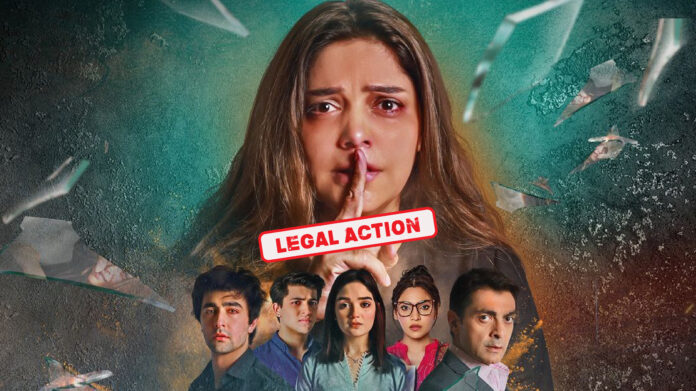
Motorway Incident Survivor Pleads Makers to Take Drama Hadsa Off-Air

Hadsa cover

Reader discretion is advised. This article contains content about sexual assault that may not be suitable for some readers and can impact your mental health. Please read it at your own discretion.

Social dramas are a frequent part of the list of dramas produced every year. In fact, this ratio has been on the rise for some time. As an audience we watch the drama, appreciate the makers for raising the voice, highlight how grave the issue is, and then we get back to our lives, paying no heed to the issue. But have we ever wondered where these stories come from and the impact translating social issues into television dramas has on the survivors of these problems?

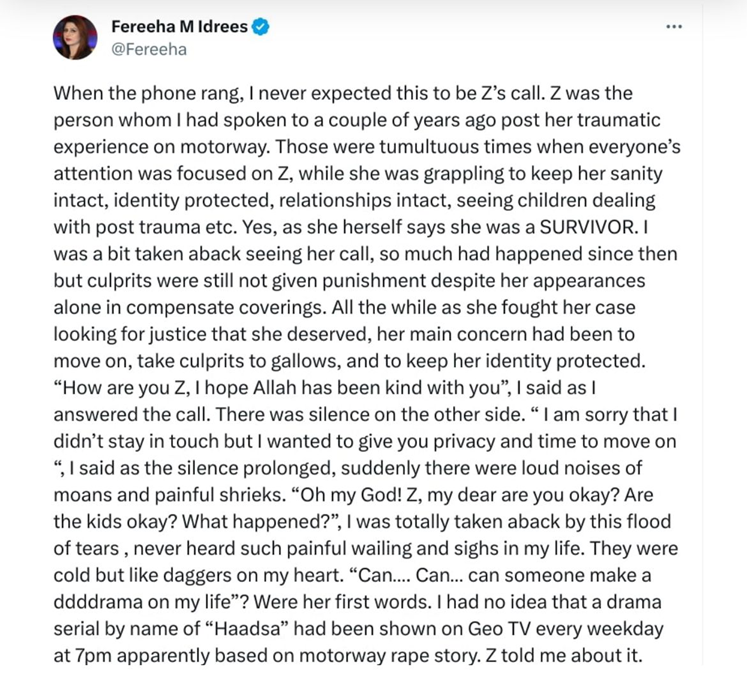
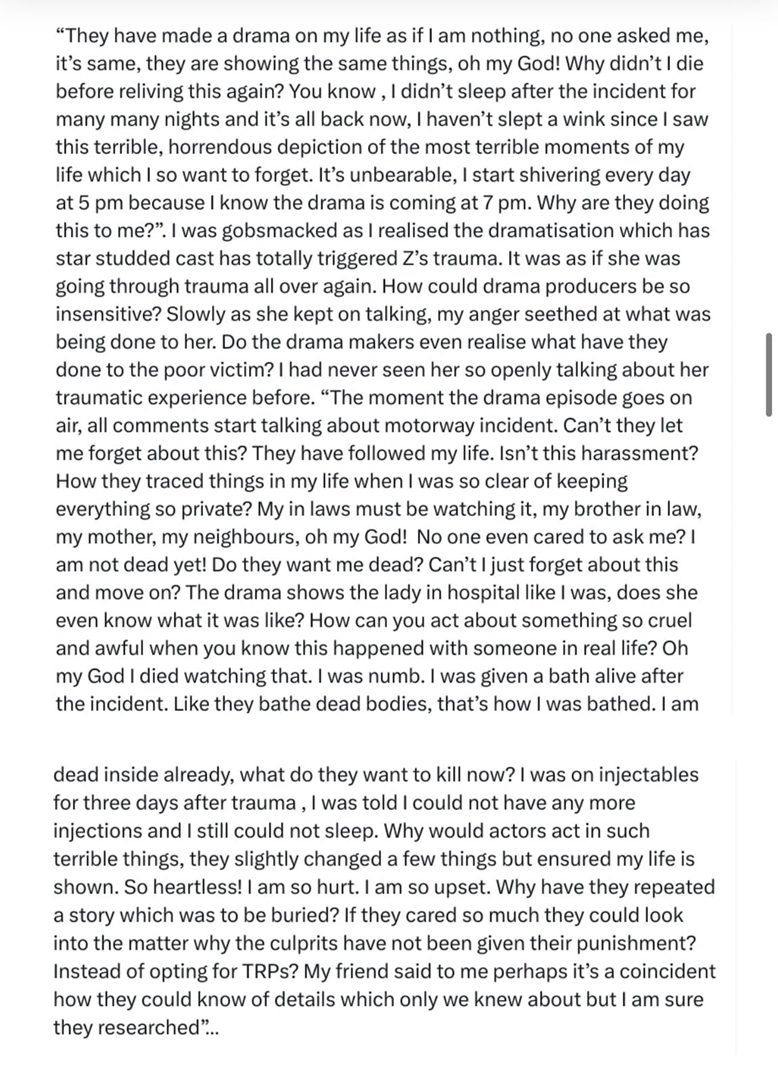
In a heart-wrenching turn of events, a somber revelation emerged when journalist Fereeha Idrees took to Twitter to unveil a poignant thread. Within it, she cast a spotlight on her conversation with the survivor of the motorway rape incident that had shaken the nation some time ago. The survivor expressed her turmoil and rage on the depiction of her real-life story in the drama serial Hadsa and how it has taken a toll on her mental health in the past few weeks.

In the thread, Fereeha highlights how the survivor was shocked to see the drama mirror small details of her personal life, which were only known to a few people. She expressed her disapproval to the makers and all the people involved in executing the drama on narrating a story from her personal life without asking for her consent.

The survivor went on to explain how she still feels traumatized after the incident and would like her identity to be left veiled. Instead, she believes this drama adds to her family’s distress and makes it harder for her to carry on with her life than it already is.

The survivor, who wishes to remain anonymous, added that her culprits have still not been caught. She feels dejected that the real problem at hand remains still unresolved and her story is being brought to light instead. She pleads that the drama is taken off-air. Following attached is the post by Fereeha Idrees:

Is The Drama Hadsa Ethical?

The question at hand is what was the intention of the makers behind creating this project? The undeniable truth is that we are not in a position where we can pass judgments on the intentions of the makers. At the forefront of this narrative is Hadiqa Kiani, the lead actress who embodies the survivor’s role. She has consistently shown her willingness to address a multitude of societal challenges head-on. As a result, deciphering the true purpose behind the drama that whether it is for ratings or narrating the story of a rape survivor is hard to tell.

We can all agree on something without a shadow of a doubt: discussing someone’s personal story without their consent is simply unethical. The survivor’s voice echoes this sentiment loudly. She expressed her heartfelt wish that her story remains untold as watching this drama makes her revisit her past traumas and has a bleak impact on her family. Given these sensitive circumstances, it’s worth pondering the genuine need for translating her journey into a dramatic portrayal.

It is also worth mentioning that according to the survivor, intricate details of her life have found their way into the storyline, indicating a level of research that can’t be dismissed. It serves as a poignant reminder that delving into someone’s life narrative without their green light is, quite simply, not on.

Should the drama be taken off-air as requested by the survivor?

The real question remains that should the survivor’s request be granted to take the drama off-air? Truth be told if in its true essence, the makers should get in touch with the survivor and either understand their perspective or make them understand their own. Only, this way can the true request of the survivor be granted.

As an audience and by-standers we cannot comprehend the agony of the real survivors of such stories. Perhaps granting their wish could be the only way we can provide some relief. However, we currently leave the matter in the able hands of all involved and hope that it is amicably sorted out at the earliest.

How Accurately Are Divorces Portrayed in Pakistani Dramas?

Sirf Tum Divorce Scene

In the ever-evolving world of Pakistani dramas, occasional slips are all but inevitable. Audiences often respond with memes, comments on the absurdity, and have fleeting questions about the art we’re churning out. In this constant loop and unbreakable cycle, we overlook a forgotten truth-the impact of these scenes and their influence.

Sirf Tum Divorce Scene

A recent scene from the 42nd episode of Sirf Tum has caused a stir among the audience. Hamza, the notorious villain in the drama, divorces his wife Amal in the heat of the moment.

Sitting in his father-in-law’s office, Hamza gets in an argument with his wife and divorces her saying, “mein tumhein talaq deta hoon, talaq deta hoon, talaq deta hoon, BOOM.” (I divorce you, divorce you, divorce you, BOOM.)

The execution of this scene was nothing but insensitive. The way Hamza ended his sentence with the word ‘boom’ implied how he felt in control and victorious, as if divorcing his wife was synonymous with child’s play.

Unfortunately, this is not a one-time incident in Pakistani dramas where we have seen the male character divorcing his wife thrice, in one setting, due to a burst of anger. We look at all the other instances where divorce has been delivered this way:

Ghalati:

The 2019 drama revolved around the plot of Zaira and Saad, a married couple whose life falls to pieces after Saad divorces his wife in an impulsive moment. The drama sheds light on the repercussions of toxic in-laws and a short-tempered husband which leads to chaos in the life of the married couple.

Nand:

Another drama showing this recurring plot is Nand. In episode sixteen, with a dramatic turn of events, Saqib divorces his wife Rabi thrice after being instigated by his sister Gohar. The drama depicts Gohar as the evil sister-in-law who can’t tolerate his brother’s wife and is adamant to make the life of Rabi a living hell. The divorce scene was executed in the most dramatic way possible, with Gohar accusing Rabi of extramarital affair and threatens to kill herself if Saqib does not take action, who eventually ends up divorcing his wife.

Kashf:

Kashf garnered praise for its effective storytelling and brilliant execution. In addition, Wajdaan’s unwavering support for Kashf was adored and idealized by the audience. However, tables turned after Wajdaan and Kashf get married and problems arise due to their different objectives. To the audience’s surprise, Wajdaan ends up divorcing Kashf, after she refuses to go with him, in front of her entire family. Wajdaan is instigated by his mother and challenged by Kashf’s father that he is not capable of taking action, due to which he ends up vocally divorcing his beloved wife.

This scene not only shattered a beloved on-screen couple that was praised by the audience, but also did not set a good precedent of a woman encouraging his son to divorce his wife.

Mann Mayal:

Even the beloved series, aired in 2016, couldn’t escape the clutches of this unsettling trend. The narrative unfolds around Mannu, forced into an unwilling marriage with Mikaeel. Mikaeel, a wealthy and arrogant young man, subjects his wife to mistreatment. Despite Mannu’s valiant efforts to salvage their union, a single day sees Mikaeel, fueled by anger and malice, divorces her and callously expells her and their children, leaving them homeless. This portrayal once again underscores the sensationalism perpetuated within such scenes.

Khaas:

The narrative orbits around Saba Faraz (Sanam Baloch), a resolute and ambitious young woman, and Ammar Saud (Ali Rehman Khan), a charismatic and attractive businessman who conceals a narcissistic nature. Captivated by Ammar’s charm, Saba eventually falls for him and agrees to marry him. However, it is only after their marriage that Ammar reveals his true colours. He subjects her to disrespect and belittlement, casting shadows on their relationship.

When Saba receives a job offer from Ammar’s own workplace, his jealousy over her burgeoning career exponentially increases, and his disapproval manifests in the most callous manner imaginable. Fueled by his wounded ego and fiery rage, he impulsively utters the word of divorce, leaving Saba shattered.

Far-reaching effects of these disturbing trends:

These instances just highlight how frequent it is to see the portrayal of husbands giving vocal divorce to their wives. This is not only toxic but wrong at many levels, sending out a wrong message to the masses, most of whom are not entirely aware about the nitty-gritty of divorce laws and Islamic rulings related to divorce.

Moreover, this narrative trend also plants seed of fear within women, due to divorce threats. In doing so, it inadvertently diminishes the sanctity of what should be a cherished and unblemished connection between partners.

Legal proceedings of divorce in Pakistan:

According to the available information available on divorce laws in Pakistan it is stated that:

As per Muslim Personal Law and under section 7 of the Muslim Family Law Ordinance the husband can pronounce talaq orally as well as by way of Deed of Divorce. The husband is duty bound to send written notice by registered post to the Union Council or concerned government office in charge of the issuance of divorce certificates.

In the said notice the husband must mention the address of his ex-wife, thereby enabling the government office to issue notices to her by registered post and it shall constitute arbitration Council within 30 days of receipt of notice for the purpose of reconciliation and settlement if possible. 

A verbal talaq is not recognized by law and the husband’s failure to send written notice to the government office is treated as no divorce in law. However, it is also important to note that as per Islamic scholars, divorce once pronounced by the husband and khula once obtained from the court of law is effective and binding.

Our Verdict

There is a thin line between adding a dramatic touch in narratives to make it appealing to the audience and going overboard where we either hurt the sentiments of the audience or signal towards a wrong message.

Divorce is a grave situation that must be dealt with sensitivity, especially in a society where women already struggle to have their demands and rights fulfilled. Dramatizing verbal divorce, and to some extent encouraging it, is damaging to society.

It is here that the makers of dramas must truly recognize their profound social responsibility. It’s essential that they refrain from weaving such distressing scenes merely for the sake of sensationalism. Balancing entertainment with ethical storytelling is the hallmark of mindful content creation, and this responsibility must not be taken lightly.

‘Hadsa’ Drama Offers a Rare and Brave Insight Into Society’s Ills  

Hadsa review

The opening plot of Geo TVs recently aired, Hadsa gives us a chance to thoroughly examine an angle of society that is often ignored i.e., a repressed mindset.

Giving the viewers insight into the title, the very first episode began with a road accident – a reflection of what’s to come so brace yourself for serious tragedies that will be coming your way throughout this plot.

Plot and Story for Hadsa

The plot brilliantly describes an array of sensitive topics such as domestic violence, victim-blaming, patriarchy, misogyny and feudalism, along with a commentary on surging street crimes – a lot to handle right?

Lauded by the viewers for playing ‘Khadija Fatima’ in the much-hyped Pinjra last year, Hadiqa Kiani this time appears in the lead as an independent, Oxford graduate and a patriotic woman — ‘Taskeen Malik’.

Being a mother of three (two sons and a daughter), Taskeen handles her household and office duties very gracefully. There aren’t many female characters in our dramas like Taskeen who manage financial and household matters in a compelling and commanding way.

The second episode, however, reveals multiple layers of Taskeen’s character as the engagement ceremony of her son Kumail (played by Khaqan Shanawaz) and daughter Bakhtain (played by Romaisa Khan) kicks off.

Taskeen’s husband Ghazanfar (played by Ali Khan) is portrayed as a strong and open minded individual who not only loves but also empowers his wife treating her as an equal and not as a subordinate, and also stands by her side through thick and thin.

Not to mention, Malik as a loving husband makes way for Taskeen to shine as much as she wants – but how long will he stand by her?

The relationship between the duo portrays an ideal marriage life till now, where the wife holds her own ground to make decisions and stand by her values. While no book (or husband) can be judged by its cover, Ghanzanfar is proving himself an inspiring husband so far, atta boy!!

Hadsa finally gives us what we’ve all been waiting for – A strong female protagonist!

Hadiqa has adorned her character with such grace and charm. There are few scenes in both of the episodes where we can say that our girl has definitely succeeded in ruling the screens and our heart as well.

Wait, there’s more! – It’s not all sunshine and rainbow in Taskeen’s world

Her relationship with her only son-in-law Waleed — a misogynist feudal lord, takes a rough turn when she refuses to send her maid’s daughter Nazma back to her home after being subjected to physical abuse by her husband Fika (a servant of Waleed).

Waleed asks Taskeen to send back the maid, keeping in mind that Taskeen wouldn’t say no to him as he holds the status of an ‘only damad’. This in essence reflects persisting and prevalent draconian cultural and social norms of a desi household where apparently sons-in-law, fueled by misogyny and patriarchy and misplaced sense of entitlement, enjoy a freehand to demand whatever they want and do whatever they want.

By turning down Waleed’s demand, Taskeen not only breaks a significant taboo by refusing to comply, but also essentially shatter the latter’s ego when she says, ‘Main kisi qeemat par usay us darinaday ke pas nahi bhejungi chahe kuch bhi hojaye’ – ‘At no cost I will send her back to that monster [of a man]’

This was followed by another viewer-favorite iconic line, ‘Apna beta hota to jawab or bhi sakht hota’ – ‘[my] response would’ve been much stringent If it was my son’ – a line that has made way into viewers’ hearts.

Spotlight on Domestic Violence

Furthermore, Hadsa accentuates another prevalent socio-cultural filth – the issue of domestic violence, with Taskeen Malik taking a stand for the victim. This scene depicts how this crime has been embedded into our society as is unfortunately treated as a ‘norm’ to an extent that the mere act of speaking about it is in fact considered ‘brave’.

Things take a drastic turn when she witnesses her maid being physically assaulted by her husband. Taskeen tries to control herself but eventually caves in. Filled with disgust she couldn’t stop herself from hitting the husband as a result. The impact of this scene is further strengthened by Hadiqa Kiani’s intense and real-life expressions.

Moreover, the third episode has revealed another aspect of Taskeen’s personality when she experiences a nightmare seeing Fika – her maid’s husband, attempting to kill her. This in essence reflects how much Taskeen is actually involved in this whole situation but didn’t step back regardless of anything – it needs a lot of patience and courage to deal with such traumatic experiences even for those who are not victims themselves but who merely raise voice for them.

What’s coming next for Taskeen in the story, indicates that more traumatic situations and circumstances are to come in subsequent episodes.

Hadsa is a daunting reflection of our society and its draconian norms!

Hadsa highlights a number of pressing issues that ail our society. Writer Zanjabeel Asim Shah and Directors Wajahat Rauf and Shazia Wajahat never fail to bring something not only unique and bold in its context, but also deliver a flawless execution as well. Additionally, Hadiqa Kiani and Aly Khan’s immaculate performance gives us a surreal life-like experience of what’s its like to be in Taskeen’s shoes.

Tragedies ahead…brace yourselves!

Considering the fact that Taskeen’s family is portrayed as a wealthy, respectable and powerful and one which takes pride in its independence and uprightness. It is yet to be seen that whether Taskeen’s family will support her if she herself is a victim of any heinous domestic abuse such as rape? Or will they fall prey to socio-cultural shackles of so-called ‘honor’ and fail to support Taskeen?

Jaisay Aapki Marzi Sets The Stage For The Chaos That Is To Follow

Jaisay Aapki Marzi first episode

Avid drama watchers will now have another interesting watch on their list with the Mikaal Zulfiqar and Dur e Fishan starrer Jaisay Aapki Marzi. The drama has been released and will be aired on ARY Digital every Wednesday.

The Story

Jaisay Aapki Marzi has been produced by Six Sigma Plus and directed by Saba Hameed. The story has been penned down by Naila Jaffri and stars Mikaal Zulfiqar as Sherry and Dur e Fishan Saleem as Alizeh. Other stars in the lineup also include Javed Sheikh, Kiran Malik, Ali Tahir, and Ali Safina in leading roles as part of an ensemble cast.

The teasers that aired prior to the drama highlighted a toxic and abusive relationship in the folds, however the first episode showed Mikal Zulfiqar as Sherry, a well balanced, eligible bachelor, easy going and with an open mindset. Sherry is ready to accept an arranged marriage situation and has relented power to his sister, Natasha, who loves to control her brother and father’s life.

On the other hand, we have Dur e Fishan as Alizeh who is ready to be the change in the world. She is focused, hard working and wants to make it on her own terms. For now the drama presents an ideal situation with an open mindset, ready to embrace and bring a change in the society. Here, arranged marriages are not looked down upon by the lead pair and both set of families are open to the idea without any chaos occurring at least in the first episode.

What We Think?

For now, Jaisay Aapki Marzi has started off on a pleasant note but we do know that this is going to grow into a tale of toxicity and abuse. What we’re hoping is that it will at least bring a new perception for the audience as we’ve already had enough of toxic relationships, controlling husbands, doormat wives. For now Mikaal Zulfiqar has played the level headed Sherry in the first episode and it will be intriguing to see how he’ll lose it when he is so certain of what he wants in life.

However, the drama from the get go has reminded us of Colleen Hoover’s novel It Ends With Us. Jaisay Aapki Marzi is giving vibes that match with the novelist’s story of an abusive relationship gone good for the better. Since its the first episode, we’ll give Jaisay Aapki Marzi the benefit of doubt and let the story unravel in due time.

Is Murtasim Khan’s Intensity Overshadowing Wahaj Ali’s Other Roles?

Wahaj Ali

The power of art is often underrated, but every now and then, an actor takes on a character so flawlessly well that it is hard for the audience to imagine him or her in any other role. Such is the tale of Wahaj Ali, who portrayed the magnetic and unforgettable Murtasim Khan in the popular drama series Tere Bin.

Fans Expect More From Wahaj Ali’s Character

Despite delivering versatile performances in subsequent dramas, Wahaj Ali has faced criticism from viewers for his portrayals in Mujhe Pyaar Hua Tha and the currently running Mein. Wahaj Ali took on the roles diligently and brought his acting prowess and passion to these characters, but audiences perceived it as falling short of the high bar set by Murtasim Khan.

With people being so enthralled by the swagger of Murtasim Khan, they have begun to anticipate and long for that same intensity in every character that Wahaj Ali plays. Expectations have been set sky-high, and viewers find it challenging to see Wahaj Ali in a different light.

Wahaj Ali as Murtasim Khan

Wahaj Ali’s compelling and captivating performance of Murtasim Khan was so impactful that people crave to see more of Wahaj as Murtasim Khan, failing to remember that he is not confined by this one character, but stands as a versatile and exceptionally talented actor capable of playing a range of personalities.

It’s undeniable that the swagger of Murtasim Khan, his brisk walks, and the classy shawl he wore have become synonymous with Wahaj Ali. Each of these character traits have become so iconically linked with his portrayal that it’s a challenge for audiences to see Wahaj Ali embody any other character.

Parallel with Gabriel Macht from Suits

A similar parallel can be drawn with the incomparable Gabriel Macht, best known for his role as Harvey Specter in the hit TV series Suits. The intensity and finesse of Macht as Harvey Specter crafted such a formidable persona that it became almost impossible for viewers to relate to any other character played by Macht post-*Suits”. His performance left an everlasting impact with audiences craving more of Specter’s charisma, wit, and barely touchable persona.

Both actors, Wahaj Ali and Gabriel Macht, are brilliant talents of their fields, they breathe life into their characters, making them seem more real than fiction. However, it’s crucial to remember that they are actors with a wide canvas to fill. Their roles may carve a niche in our hearts, but it’s important for viewers to appreciate their range of capabilities and potential to enthral us as diverse characters.

The Art of Storytelling and Gripping Performances

In a broader sense, this phenomenon brings to light the power of storytelling, compelling performances, and the grip they can maintain on an audience’s psyche. But as admirers of their craft, it’s also a reminder for us to applaud their talent and versatility, recognising the impact they have made with a role, while also eagerly awaiting to be mesmerised by their ability to deliver equally captivating portrayals in the future.

Let’s appreciate Wahaj Ali for his outstanding portrayal of Murtasim Khan but also look forward to witnessing the breadth of his talent as he embraces new characters and adventures in his acting career.

Have Pakistani Dramas Failed At Setting Patient-Therapist Relationships?

Pakistani Dramas on Mental Health

“Loog kya kahien gay?” (What will people say?)—a seemingly innocuous question, yet one that wields remarkable power, shaping the very contours of our existence. It holds so much power that we let this statement influence our decisions. Talking about mental health and getting treatment for it is one of them.

In a landscape marked by a staggering prevalence of mental health challenges in Pakistan, our society stands at an impasse, reluctant to recognize these struggles and actively resistant to accept that people need treatment. In this gloomy landscape enters the power of entertainment portals, which are a powerful lens that present unspoken narratives of our society find expression, fostering a dialogue that holds the potential to reshape perspectives and ignite change.

Over the years, we have seen television dramas integrating the plot of mental health into their narratives. Some did a job well done, while others received criticism for their inaccurate depiction of a serious subject.

Let’s look at Pakistani dramas, over the years, that have made an attempt to highlight mental health issues and their success in doing so.

Mein: False Portrayals and Missed Marks

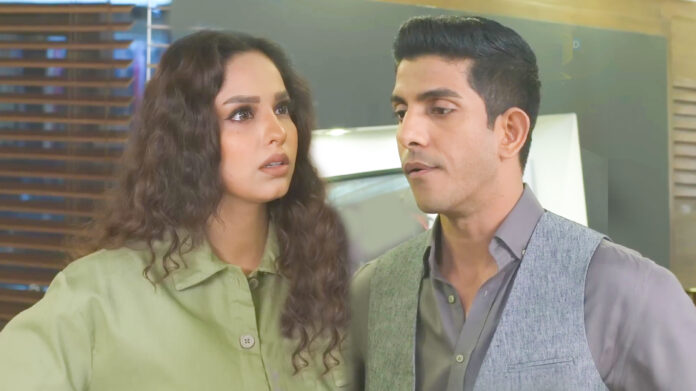
The currently airing drama Mein starring Wahaj Ali and Ayeza Khan came under shrewd criticism following a psychiatrist-patient scene in the third episode.

The story follows a self-absorbed, arrogant, and stubborn woman Mubashira who ends up getting a divorce from her husband on the night of her wedding anniversary party. Mubashira goes nuts after being humiliated in public and threatens to kill her ex-husband. Her haughty attitude does not end there, and she continues to insult people. Her worried father agrees to get a psychiatrist on board.

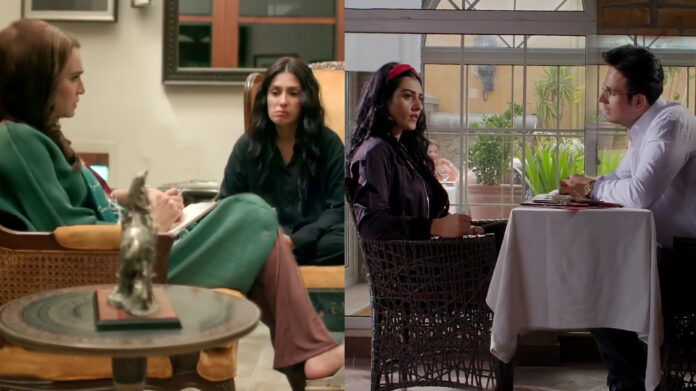
And oh boy it all went downhill from there. Hear this, Mubashira and her psychiatrist have a session in Mubashira’s house, sitting within close proximity. Their conversation unfolded like pep talk and ended with the psychiatrist holding Mubashira’s hand. The mindless execution of this scene just goes on to represent the lack of research that goes into translating such a sensitive scene on television, thus setting a wrong precedent and expectations of the masses.

Sabaat: Unveiling mental health missteps

Considered to be one of the biggest hits of 2020 and yet unfortunately Sabaat is another addition to the list of dramas that failed to portray the subject of mental health with sensitivity and accuracy.

In the drama we see Miraal (Sarah Khan) a rich and spoiled daughter of a businessman who has the urge to control everything in the life of her loved ones. After the demise of her maternal grandmother, Miraal experiences visions which disrupt her mental health. To seek help, Miraal starts to visit a psychiatrist – Dr. Haris (Usman Mukhtar).

Following Dr. Haris’s entry, the drama received wide criticism on social media when some of the scenes made it clear about the blooming romance between Miraal and Dr. Haris. Rumor has it that some scenes were reshot to minimize the damage of showing a romantic relationship between a doctor and his patient. Nevertheless, some scenes were still questionable and not executed well. In addition, while Miraal’s mental illness was a major plot, it wasn’t explored well by the director and the writer. Her journey to recovery was haphazard and the audience had to make a wild guess about type of Miraal’s mental illness.

Unfortunately, this execution is another testament of how we treat mental health in general. In a society, where masses do not have mental health awareness, even a hint towards romanticizing psychiatric-patient relationship is damaging and just goes on to highlight the unhealthy expectations of therapy dramas promote.

Jhoom: Breaking barriers with accurate depiction of mental health

A breath of fresh air among the sea of dramas highlighting mental health is the recently mega-hit project Jhoom.

Through Haroon Kadwani’s character Aryaan, the drama dives deep into addressing mental health issues including anger management and depression. With grace and sensitivity, the makers highlight the story of a man who suffers from depression due to his traumatic past.

Jhoom highlights anger issues in the character, without glorifying them, and the makers did a great job in emphasizing how imperative it is to address them and seek treatment for it to avoid the gloomy consequences that can follow.

Furthermore, the drama also depicts society’s ill-treatment towards a patient with depression and how it makes it hard for those who are on the journey towards recovery. An iconic dialogue of Aryaan, that is still remembered “kabhi aap jeet ker bhi haar jatay hain”-highlighting the turmoil of such individuals who despite winning their battle with mental health are still scrutinized and lead down by people.

Saraab: Confronting the society’s ignorance on Schizophrenia

A directorial venture of Mohsin Talat, Saraab attempts to highlight schizophrenia, a mental health issue often shrouded in misconception and societal indifference. Through the lens of Hoorain (Sonya Hussyn), the series bravely delves into the intricate challenges faced by those grappling with hallucinations, delusions, and disordered thoughts.

The drama mirrors reality as it shows how Hoorain’s family is unsupportive and plans to get her married, considering it will magically solve all the problems. They also turn to peers, get taweez for her, and turn to mystics and charms rather than seeking professional medical help.

These sad turns of events go on to show society’s failure in addressing mental illnesses of various kinds. Saraab offers a window into the complexities of schizophrenia and encourages the viewers to educate themselves about this grave issue.

Ye Dil Mera: Unravelling veiled realities of PTSD

In the realm of psychological thrillers, Ye Dil Mera aimed to unravel the veiled realities of Post-Traumatic Stress Disorder (PTSD). The narrative cast a spotlight on the poignant journeys of two central figures, Noor-ul-Ain (Sajal Aly) and Amaanullah Khan (Ahad Raza Mir). Both characters bore the weight of traumatic pasts, their experiences etching scars that time could not erase, molding their very identities.

In a pivotal moment, the story unfolds the narrative of seeking help from a professional for Aina, however her father Agha Jan (Adnan Siddiqui) is sceptical and considers therapy as a taboo. This issue is put to rest after Agha Jaan is schooled by the psychiatrist, a message also directed to the audience.

Despite its flaws, the drama aptly presents how ignoring mental health issues can prove to be problematic and these untreated traumas continue to haunt. The audience is drawn to sympathize with the trials of the main characters by recognizing the profound toll of untreated mental health and how some stories have to be put to rest in order to begin a new chapter.

There are numerous other dramas that have delved into mental health and various pressing concerns that deserve attention. However, the key takeaway is to fully grasp the intricate nature of these narratives and recognize the gravity of mental health issues. Dramas wield a formidable influence as a medium to bring to light topics often shrouded in silence.

Thus, it is critical for the makers to understand their responsibility and craft compelling narratives that effectively convey the right message, especially when it comes to representing a subject as sensitive as mental health.

Emotions Ride High In The Teaser Of Shoaib Akhtar Biopic “Rawalpindi Express”

Rawalpindi Express Biopic

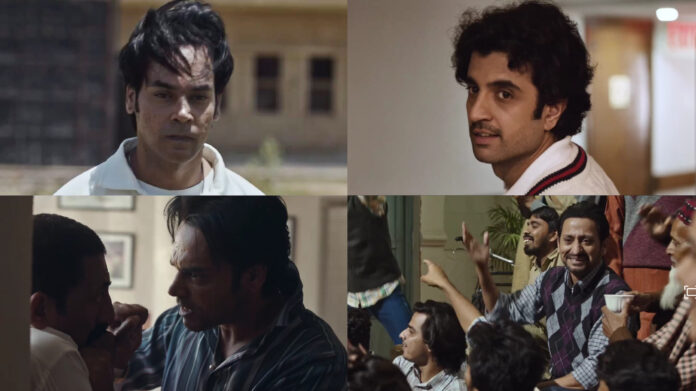
Gohar Rasheed plays Shoaib Akhtar in his latest biopic and manages to impress as the beloved Rawalpindi Express. The movie will largely follow Akhtar’s life and struggles as he becomes one of the world’s fastest bowler, making a mark for himself in international cricket.

We saw a glimpse of the picture in the recently released teaser for Rawalpindi Express and will discuss our views here.

The Story

The teaser begins by showcasing a baby born with a problem. The mother is worried but the kid is determined to run and run fast for Pakistan. Scenes then build about narrating Shoaib’s journey from when he didn’t have any popularity as a rookie operating from a backward place with misplaced enthusiasm yet loads of determination and confidence.

As Shoaib Akhtar, Gohar Rasheed has a determined appearance, hard and roughened, very apt for the part. Written by Qaiser Nawaz and directed by Muhammad Faraq Qaiser, Rawalpindi Express brings across a tale of a cricketer who won against all odds.

The Reception

The teaser was greeted with appreciation in the world of cricket and film fanatics alike. Cinematography seems at par with the best films to have released in Pakistan over the last year, however one cannot help wonder if the life events showcased in the movie have been more or less dramatized for the sake of cinema.

Gohar Rasheed, who is an actor par excellence, has perfectly moulded himself, his accent, body language and vibe pretty much similar to that of the former Pakistani fast bowler. Akhtar’s determination is put across as strong as iron by Gohar Rasheed despite the mocking and laughing he is shown to be receiving at the hands of friends, foes and family.

For now the teaser offers an interesting peek into Shoaib Akhtar’s life as the Rawalpindi Express and considering the fan following the ex fast bowler enjoys, it won’t be incorrect or much too hopeful to expect the film to do decent business once it hits cinemas all over.

Meet The Star-Studded Cast of Pakistan’s First Netflix Original

New Netflix release cast

Pioneering a new phase in global storytelling, Netflix has announced its first-ever Pakistani original series. This series isn’t just any production, but a riveting adaptation of “Jo Bachay Hain Sang Samait Lo“, the widely acclaimed Urdu novel penned by best-selling author Farhat Ishtiaq back in 2013.

Star-Studded Cast Revealed

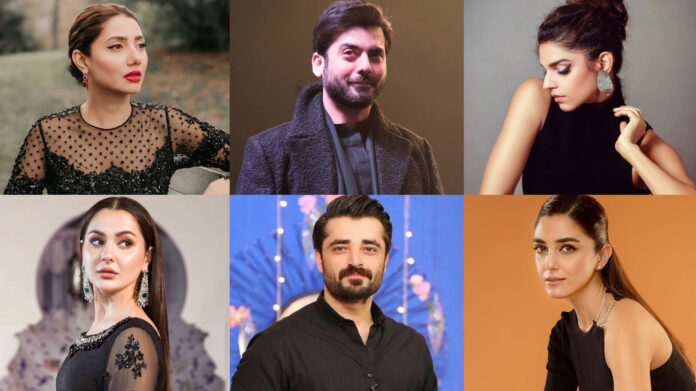
Joining the series are renowned Pakistani actors Fawad Khan, Mahira Khan, Hamza Ali Abbasi, Hania Aamir, Ahad Raza Mir, Sanam Saeed, Bilal Ashraf, Iqra Aziz, and Maya Ali.

The ensemble cast is further bolstered through the inclusion of Samina Ahmed, Khushaal Khan, Nadia Jamil, and Omair Rana, notable for their significant roles in respective highly-rated Pakistani films and dramas.

From the looks of it, Jo Bachay Hain Sang Samait Lo is destined for greatness. Besides the novelty of Pakistan’s first Netflix original series, the upcoming release also has a stellar cast and will cover exotic locations across the globe.

Plot Overview

The narrative orbits around two central characters — Sikandar, a Harvard Law student whose life transforms following an extraordinary incident, and Liza, a bubbly yet haunted artist with a troubled past. Their paths intersect in Italy, thereby unfolding a captivating tale that is sure to capture hearts and minds.

It is to be seen how the story rolls out and what unique global flavors Netflix adds to one of Farhat Ishtiaq’s best works.

Speculation Put to Rest: An Anticipated Reveal

For years, ardent fans and industry insiders have been speculating about the possibility of a Netflix original series from Pakistan. Rumors regarding the cast and crew have swirled relentlessly, sparking excitement amongst the Pakistani entertainment industry and its supporters worldwide.

This much-awaited confirmation has thrilled fans who have been following the rumors around the adaptation of Farhat Ishtiaq’s novel. It reinforces the immense potential and unique voices Pakistan presents in the entertainment arena.

Production Details

Overseeing the project’s production is Dubai-based Momina Duraid Films FZ – LLC, with seasoned producer Momina Duraid leading as showrunner. The commission for this Netflix original comes from the company’s Middle East and North Africa team.

Location and Release Details

The series is currently being shot across various picturesque locations in Italy, the U.K., and Pakistan. Despite the buzz around the project, there is yet to be an official announcement regarding the streaming date.

A Milestone Achievement for Farhat Ishtiaq

With Netflix’s adaptation of her critically acclaimed novel, “Jo Bachay Hain Sang Samait Lo,” Farhat Ishtiaq once again proves her storytelling powers in the realms of television and digital media.

Ishtiaq’s literary works have previously featured on-screen. Notable adaptations include “Humsafar,” “Mere Humdum Mere Dost,” “Matae Jaan Hai Tu,” “Diyar-e-Dil,” “Bin Roye,” and “Yaqeen Ka Safar”.

As this Netflix original slowly takes shape with a star-studded cast, a gripping storyline, and diverse shooting locations, fans around the globe eagerly anticipate its arrival on the streaming giant’s roster.